Have you ever walked into your favorite coffee shop in September and seen that they have started selling pumpkin spice lattes? That is an example of seasonal marketing, and it applies to your business website as well. Just as they prepare to ride the wave of interest in seasonal products, you should prepare to ride the incoming seasonal interest in your business using seasonal SEO.
While regular SEO helps you build your business’s online presence, seasonal SEO helps you to take advantage of the times when folks are searching specifically for your products and services. For example, if you sell products and services that can be advertised as holiday gifts for mom, you should release that content in November so that you can be found by folks looking for that product. Content creation timing is key to optimizing your business visibility.
In this guide, you will learn how to optimize your visibility when it is most important, including how to identify and capitalize on time-sensitive trends before your competition.
What Is Seasonal SEO?
Seasonal SEO is how your website tailors your content to customer interest during particular times of the year. While traditional SEO tries to get you traffic consistently year-round, seasonal SEO tries to give you traffic during the year and capture interest during spikes for certain topics.
These spikes happen in customers’ purchasing behaviors. For example, Christmas is a huge shopping season, and the decorations come out earlier and earlier each year, so people can get a head start on the presents. Parents in August spend a lot of money during back-to-school shopping. The weeks in March and April get slammed for tax season. Right after the winter holidays, customers start to book summer vacations, so resort destinations need to get their ads out.
Here are a few examples of how smart businesses do SEO seasonally. A retailer who sells Christmas trees won’t wait until early December to start pushing Christmas tree sales. An SEO tax prep service ad campaign won’t wait until March. By thinking ahead like this, similar to the comprehensive SEO strategies used by successful businesses, you are ahead of the competition for seasonal SEO.

The real magic lies in how you have compelling content that is waiting for the customer to find it. Instead of having to rush to make a Valentine’s gift guide on the 13th, intelligent companies have that content published and optimized weeks in advance.
What Are Seasonal Keywords?
Just like fashion, seasonal keywords have a runway even if they eventually get old again. They include evergreen keywords like how to lose weight, and seasonal keywords like christmas cookie recipes and summer workout routines that have seasonal spikes.
The hard part is to find the seasonal keywords right before their peak. I have seen companies lose a lot of potential customers because they started their keyword search too late. By the time they published content, the seasonal wave already settled down.
What is particularly noteworthy about seasonal keywords is the intent behind them. If a searcher is looking for “Mother’s Day gifts” in the month of April, they are not window shopping. They are ready to make a purchase. Seasonal keywords also yield a higher conversion than other, non-seasonal keywords, even though these other terms are more frequently searched throughout the year.
Sophisticated businesses utilize Google Trends to guide their business decisions, but most people often fail to recognize that the trends are not just for seasonal interest; they also have predictive capability. Assuming there was a noticeable rise in the number of people searching for “pool supplies” last April, it is reasonable to expect that a similar increase will be observed in April of this year. As voice search becomes more prominent, keep in mind that seasonal queries are often phrased differently than typed. “Near me” searches increase significantly during holiday shopping seasons.
What Is Seasonal Content and How to Create It?
Effective seasonal content involves more than adding “Christmas” to the title of a blog post. The best seasonal content solves specific problems your audience faces during particular times of the year.
The majority of seasonal content engages audiences during three periods. People want to learn:
- 1. What to do before an event (preparation content)
- 2. What to do during an event (peak-season content)
- 3. What to do after an event (wrap-up content).
For example, in October, a financial advisor may want to publish content that helps people manage holiday spending, something to the effect of, “How to Budget for Holiday Expenses.” Then, in December, she may want to publish something like “Last-Minute Tax Deductions.” Finally, in January, she might publish something that helps people with their financial goals, “New Year Financial Resolutions That Actually Work.”
The most important thing to consider, using your SEO metrics from previous seasons will reveal the content that drove the most traffic, aided in bringing converting visitors, the seasonal articles that met the goal of the season, and the seasonal keywords that helped achieve the goal. This data is your roadmap.
Here is the seasonal content strategy most businesses miss. Creating seasonal content, leaving it, and after the season ends, abandoning it, is the incorrect approach. The best businesses use that off-season time to update and improve their seasonal pages. When summer rolls around, “Best Summer Vacation Destinations” will be an established (Google trusts the content) and fresh (with locations, new photos, and updated pricing) piece of content.
Your seasonal content list should contain:
- Hyperlocal seasonal content targeting ‘near me’ searches
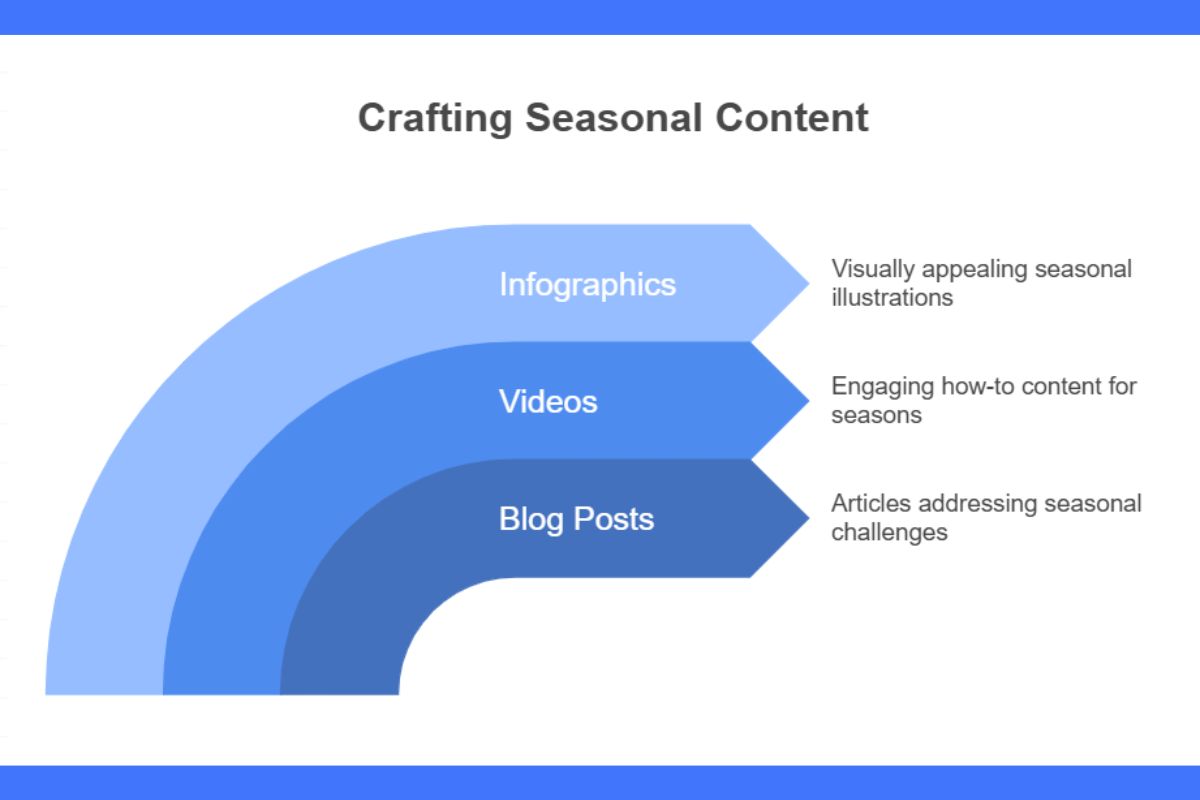
- Blog posts addressing seasonal pain points
- Resource page planning for the season
- Product descriptions updated with seasonal use cases
- Videos demonstrating seasonal use cases
Why Seasonal SEO Is Important?
The numbers speak for themselves, and businesses that manage to focus on seasonal SEO see increased revenue and traffic during peak seasons. The interesting part is that the benefits of sharp seasonal SEO are not only during peak seasons.
Repeatedly meeting customers during peak seasonal pain points builds a strong sense of trust and authority. Becoming the ‘top-of-mind’ brand for customers when they need seasonal products and guidance is how SEO builds a brand.
Let’s go over a real-world scenario. A landscaping business creates content based on the time of year. In the spring, they might create content based on new plants, and in the fall, they create content based on the fall cleanup. In the winter, they might create content based on winter preparation. In the summer, they could create content on summer maintenance. It isn’t just about capturing the season’s interests, though. It is about representing the business as a local authority during the season. If a local homeowner has a landscaping emergency in the middle of July, whose business do you think they will call?
Seasonal SEO brings in high-value customers ready to convert, increases brand visibility when interest is hottest, and provides relevant content to assert authority in the niche. It also creates multiple touchpoints in a funnel to lead customers to the desired action. When a business is relevant year-round, they increase customers’ lifetime value.
People often fail to consider the importance of seasonal SEO when talking about business impacts. When discretionary spending drops, businesses with diversified seasonal presences are less exposed to the risk than businesses standing on a single busy season.
Benefits of Seasonal SEO for Both B2C and B2B
One of the many beauties of seasonality in SEO is that it can help both B2C and B2B companies, albeit in different ways. Retail companies (B2C) can take advantage of heightened visibility, impulse purchases, and better conversion rates as buyers become more motivated to purchase.
However, the opportunity for B2B companies is even more significant. Still, it’s surprising that many companies neglect the opportunity. Seasonal patterns can also be found in business decision-making. For example, budgets are typically set in the 4th quarter for the upcoming year, and new projects are often initiated in the 1st quarter. Then, the second and third quarters are reserved for mid-year reviews, which often open the door for new vendor searches.
So, a software company, for example, might create a blog post to help it rank for the term “Q4 budget planning for IT departments” in hopes of capturing B2B buyers at the right time in their decision-making process. The same is true for professional services firms that often become inundated with new clients during tax season, fiscal year-ends, and compliance deadline periods.
Key Benefits for B2C:
- Enhanced Brand Awareness: Heightened brand presence during competitive shopping times.
- Common Content Themes: Content themes that align with the consumer mindset.
- Impulse Purchases: Seizing opportunities for spontaneous purchases and gift buying.
- Emotional Triggers: Increased conversion rates during emotionally driven buying moments.
Key Benefits for B2B:
- Decision Stage Lead: Generating leads during critical business decision time frames.
- Purposeful Positioning: Timing during natural vendor assessment for optimal positioning.
- Budget Cycle Alignment: Syncs with business planning schedules and budget cycles.
- Insight Authority: Building thought leadership via relevant and timely business insights.

The thriving companies with seasonal SEO B2B and B2C seasonality often do counter-intuitive things. B2C consumer purchases tend to slow down after holiday spending in January. Meanwhile, B2B businesses begin to start annual planning and have new, fresh budgets to allocate.
Impact of Seasonal SEO on B2C and B2B
Seasonal SEO has challenges. There are benefits, such as seasonal patterns, but so are the challenges. There are opportunities for businesses, but if they have poor planning, they may experience a frustrating, unsteady, and tumultuous period driven by inconsistent revenue and traffic.
The largest pitfall I see companies falling into is putting all their focus on seasonality. A retailer specializing in Halloween costumes is not thinking outside the box if they are only trying to drive traffic in October. A tax service that only creates content in April is missing all the other opportunities in the remaining eleven months. To make things worse, they are fully reliant on one tiny seasonal moment to be an overall success.
In peak seasons, the competition is tougher. Keywords that felt candid to target in July, like “Christmas gift,” become a warzone in November. Established brands with a higher spend can easily drown smaller brands out of visibility in the highest traffic times.
It’s a different issue for B2B companies, albeit a little simpler and just as challenging. Conference planning services need to grab the attention in January, and not lose it, for events happening in Q3 and Q4. The lag between customer intent and the buy button requires a different kind of nurturing focus that is longer-term in nature.
Many businesses do great content for the season, but don’t build the authority around the topic for the rest of the year. For example, Google doesn’t reward just the season, but the overall authority and trust of the site. This is why it is so difficult for new businesses to rank for things like “black Friday deals,” because they are competing with the authority of huge brands with established and trusted content.
This doesn’t mean that businesses should shy away from doing seasonal SEO. It just means that it should be part of a wider strategy for the rest of the year, with seasonal content building upon that to amplify the rest of the work.
The Impact of Seasonality on SERPs
Because of a change in season, the Search Engine Results Pages, or SERPs, change dramatically, and for businesses to have the visibility they want during the peak season, it is important for them to understand the shifts. Google’s algorithm works differently during the peak season, and will reward fresh new content that rings the cash register for the consumers who are ready to buy.
These are the significant buying dates – Black Friday and Cyber Monday – and it is important to watch for the shifts. You will see that the pages that were indexed well a few months prior to the buying seasons will not be the same ones that are indexed well during the buying seasons. This isn’t seen as untrustworthy content. Google is simply looking to see what the public wants and provide them with it.
It is noteworthy to consider how local seasonality influences search outcomes in unique ways across multiple locations. For example, searches for “winter coats” will peak in October in Minnesota, but in Texas will peak in December. Google’s algorithm is designed to understand these local nuances, which is why your seasonal SEO strategies must incorporate the geographic locations of your customers, in addition to the timeframes they are targeting in their searches.
The expansion of voice search and Featured Snippet Search has complicated the seasonality of search engine results pages (SERPs). Google tends to favor quick, direct responses in Featured Snippets during busy holiday seasons. For example, the query “how long to cook Christmas turkey” will likely activate a Featured Snippet, and therefore will bypass the more traditional organic search results.
During seasonal peaks, here are the key changes:
- More recent content is shown instead of older, more authoritative pages
- More emphasis is placed on local and geo-targeted results
- Featured Snippets provide more seasonal, practical, and how-to content
- Commercial searches are overtaken by Shopping results and Product Listings
- Higher emphasis on situational and locational intent for the mobile results
During seasonal events, smart companies adjust their strategies and monitor search engine rankings more closely. The companies that succeed are those that view seasonal changes in search engine results pages (SERPs) as opportunities rather than obstacles.
Planning Seasonal and Holiday SEO for Maximum Impact
Timing is crucial when planning for holiday SEO. Successful businesses for Black Friday started their content planning during the summer. A good business owner understands the customers’ timeline and not just their own business timeline. Christmas shopping season for customers actually begins in September and October as they conduct gift research. Also, vacationers are more than likely planning summer vacations in, looking as early as February and March.
A good approach businesses should take is to start seasonal content planning 90 to 120 days in advance. Content calendars should be focused around tools such as Google Trends to pre-determine when interests for the business will start to arise, and not just the peak periods for content creation. While many businesses will focus their content towards the peak periods, they should really look to capture the attention, building towards the peak periods.
During peak periods, businesses should be looking for seasonal SEO and preparing the back-end for the seasonal spikes in business. A website that cannot sustain the traffic spikes is going to lose visitors and potential customers, and going to be very frustrating for the business to be ranked high for a valuable holiday season keyword.
Effective seasonal planning involves multiple strategies. Here are examples:
- Creating content at least 3-4 months in advance
- Performing technical infrastructure tests in order to prepare for possible traffic spikes
- Optimizing the site for mobile (as seasonal shoppers tend to be on mobile devices)
- Optimizing local SEO for seasonal “near me” searches
- Coordinating social media to amplify seasonal content
- Scheduling Email marketing to support seasonal SEO efforts
Businesses that excel in the strategies above not only experience seasonal traffic spikes but also enjoy sustained growth year after year as their seasonal authority increases with Google and their audiences.
Combining data-driven decisions with a flexible, adaptive approach allows effective seasonal and holiday SEO. It helps capitalize on seasonal opportunities and maintain strong performance throughout the year.

FAQ
Seasonal keywords will spike in search volume at specific times (for example, “Halloween costumes” in October), while evergreen keywords have search volume that stays consistent throughout the year (for example, “home improvement tips”). The most important distinction is the timing and the searcher’s commercial intent; seasonal keywords will have a greater purchase intent during the times that they peak.
The industries that benefit from seasonal keywords strategies in SEO that are the most include Retail, e-commerce, travel and tourism, Event Management, Financial services (tax time), home services, and any business that is linked to a holiday, a weather change, or a cyclical life event. Even traditionally, “non-seasonal” B2B businesses have seasonal business cycles along with predictable patterns in decision-making and budgeting.
Holiday SEO Strategies are strategies that should be implemented at least 3 to 6 months before the holiday.
Start content creation at least 2 to 3 months before the holiday, competition for the holiday will increase, and you want to be best prepared before the holiday.
Your Next Steps
There really are no magic tricks to the way these successful businesses have been able to incorporate seasonal SEO into their practices. They have been able to pre-plan their strategies and integrate customer-centric practices into their businesses. Develop your seasonal content and strategies well in advance, perhaps in the 3 to 4 month range, and develop content to solve customer issues during peak times. And, as we have said, in the long run, consistency outperforms perfection.
Developing successful SEO practices is relevant to all businesses and, in this case, considering the upcoming holiday and budget season, as well as B2B and beyond, successful practices integrate planning. Pre-plan periods with high consumption, and accompany them with high-quality content. Establish this content with the trust that Google places in you as a reliable resource.
IZ SEO is your go to experts when you are ready to implement Seasonal SEO strategies and develop growth potential beyond seasonal opportunities.