As a business owner, the SEO and Google Ads puzzle on how to grow your business online is something you will have to deal with at some point, as they are arguably the two most famous and widely used strategies to increase traffic to your site, although they do vastly differ in the ways they accomplish this task.
So, what is the difference between SEO and Google Ads, and how do you determine what is best for your business?
In this case, we will need to examine each individual method, what the differences are, how each is best implemented, and in some cases, both need to be used at the same time.
Let’s get to the bottom of these two marketing strategies.
What Is SEO?
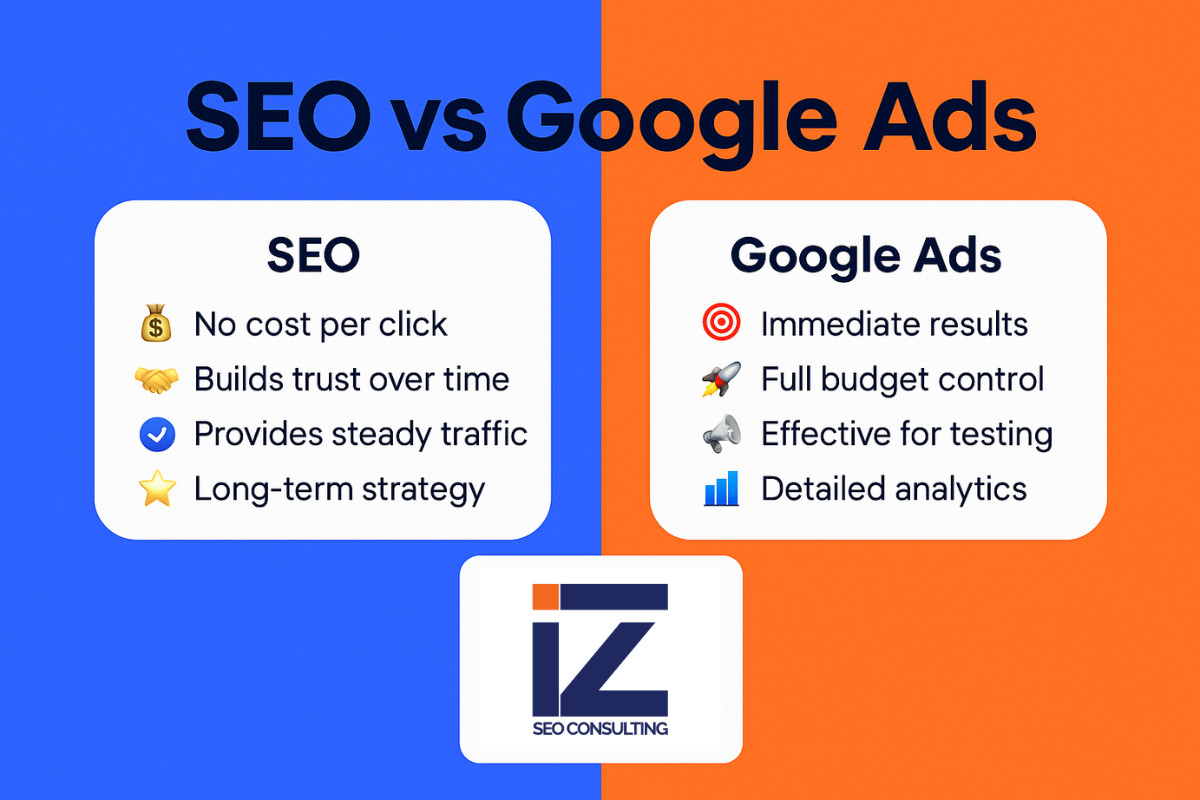
SEO stands for Search Engine Optimization, and this is the practice of attempting to get your site to appear in the free, organic, or natural search results on Google. To accomplish this, you need to create content that is relevant to what is being searched, make sure your site loads quickly, is mobile-friendly, and make sure you target the right keywords.
Unlike paying for clicks, SEO creates a space for your website in the search results by proving its helpfulness and trustworthiness in the eyes of search engines.
Why SEO makes sense:
- Remaining cost-efficient
- Making the audience trust over time
- Creating consistent website traffic
- Fulfilling long-term goals of your marketing strategy
- Enhancing user experience optimization of the website
Especially when combined with effective SEO techniques centered on content creation, site performance, and user intent, SEO provides the most results in the long run.
Nevertheless, SEO is a long-term strategy. It’s not instantaneous, which is where Google Ads come in.
What Are Google Ads?
Google Ads is where you pay to come to the top of search results. You choose keywords, set a budget, and when someone clicks on your ad, you pay. You write your ad.
This kind of advertising is called pay-per-click (PPC) advertising. It’s the quickest way to gain traffic, especially when you have a new product, a sale, or when you want to gain visibility.
Why do you think Google Ads is useful?
- Results can start coming in minutes as you start getting traffic
- You control your budget as well as your ad spend
- You can test new ideas and offers
- You can reach people who are ready to make a purchase
- You know what’s working, as the data is clear
Once your budget is done, the traffic stops coming unless you restart your ads. Unlike Google Ads, SEO traffic can keep flowing in even without a budget.
Difference between Google Ads and SEO
Let’s start looking at the difference between Google Ads and SEO. We will focus on 3 things in particular: budget, time, and long-term value.
What is the cost?
SEO is time and money-intensive due to the need to create good content and optimize the structure. But getting traffic after you’re done optimizing the site can be free.
With Google Ads, you will start getting traffic as soon as you set up your ad. This is especially useful if you are working with time-sensitive offers. However, you will start accumulating traffic costs every time someone clicks your ad. It can quickly add up, especially for competitive industries.
What is the cost?
With SEO, you will need to put in the necessary time to create good-quality content and structure the site. However, once the site starts gaining traffic, you won’t have to pay anything.
SEO is time-consuming, and results take weeks to appear. So, if you choose this route, you will need to be patient. The results will come, though!
How About Long-Term Value?
SEO can drive traffic as long as you continue to update and manage your content. Think of it as a solid foundation built to last.
With Google Ads, traffic is only driven until a set budget is reached. It’s more like turning a light switch on and off than building anything.
Which Builds More Trust?
Most people trust results that appear organically (SEO) more than ads that show because they feel like they actually earned the spot.
With that, Google Ads can target and reach people ready to take any kind of action at that very moment, and they can choose the ads and content themselves.
Which One Gives You More Control?
With Google Ads, it is entirely up to you to set the keywords, content of the ads, and even the schedule it runs on.
SEO is less in your hands and offers less overall control. It requires more time to go through changes and more attention to test and fine-tune.
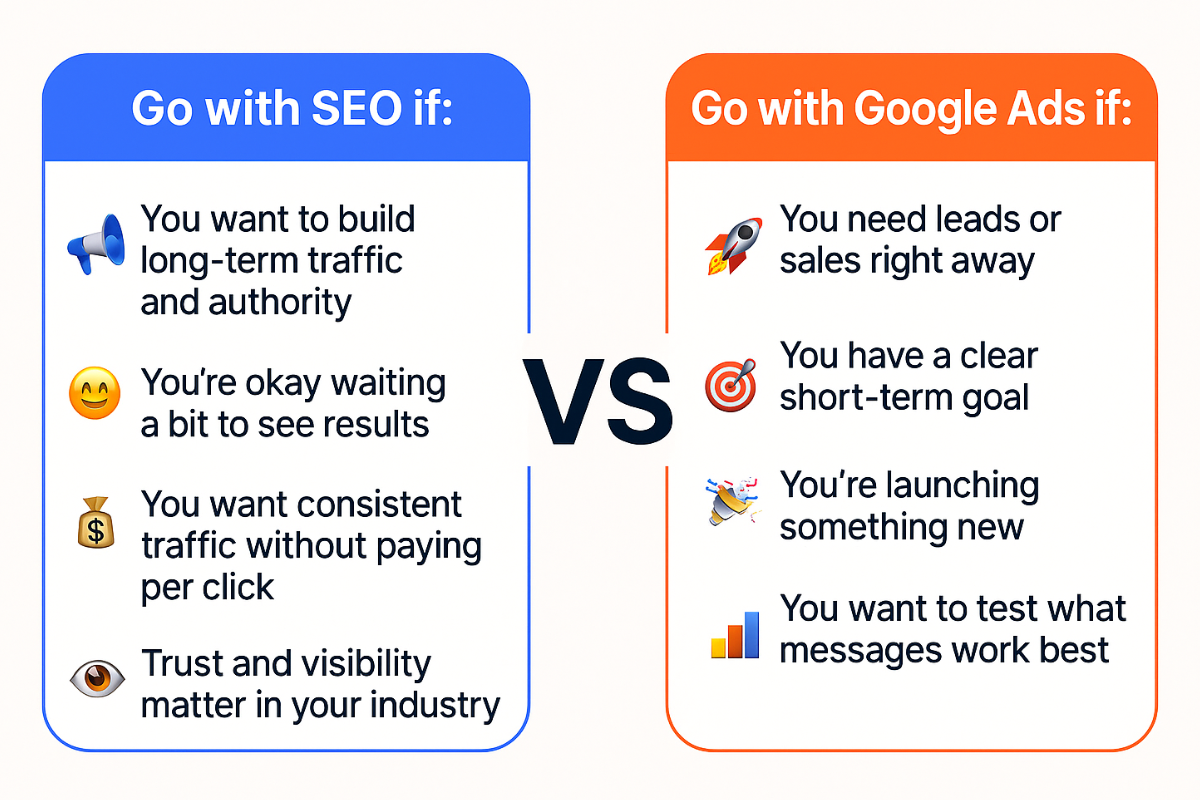
Which You Should You Choose?
Having to make a decision can be difficult, so here’s a straightforward approach on how to proceed:
Can You Use Both Together?
Yes – and often, that’s the best way forward.
Using both strategies gives you the best of both worlds. While SEO is working to build your site’s authority and visibility over time, Google Ads can bring in traffic right away.
Here’s how that works in practice:
Let’s say you’re a local dentist launching a new location. You use Google Ads to promote your grand opening, get appointments fast, and test which services are most popular. At the same time, you work on local SEO to build your long-term presence for search terms like “dentist near me” or “emergency dental care.”
As your SEO improves, you can ease off the ad spend. Or keep both going for maximum impact. This combo approach also helps you strengthen your brand by showing up in more places and becoming familiar to your audience.
Let Google Ads Guide Your SEO
Finally, here’s something most beginners miss: Google Ads can actually help improve your SEO game.
How? Use ads to test which keywords and messages drive the most clicks and conversions. Once you know what works, you can focus your SEO efforts on creating content around those high-performing keywords.
This saves time, avoids guesswork, and increases your chances of ranking for keywords that actually bring in results.
FAQs
SEO isn’t instant. It usually takes 3–6 months to see noticeable results, depending on your industry and competition.
Yes, especially if you want fast results or need to promote something specific. You can start with a small budget and scale up based on performance.
Not directly. Running ads doesn’t improve your organic ranking, but it can help you understand what keywords and content perform best, which you can then use to improve your SEO.
While you’re not paying per click, SEO does require time, effort, or budget if you hire help. It’s more of an investment than a direct cost.
Yes. A focused, high-quality landing page helps improve your ad performance and boosts conversions. Google rewards better landing pages with lower costs and higher rankings in the ad system.
So, to Sum Up – SEO vs Google Ads, Which Is Better?
To conclude our story on which is better, SEO or Google Ads, it’s safe to say that the answer completely depends on what you need right now.
If you want quick results, Google Ads is the way to go. If you’re in it for the long haul, SEO gives you more value over time.
But often, the most effective strategy is to use both together.
So, ready to grow smarter online? Don’t choose blindly.
Understand the differences, find what fits, and let your marketing work both short-term and long-term.
And, ultimately, for a well-balanced digital strategy tailored to your business goals, consider working with Indexed Zone SEO experts, where insights, transparency, and strategic execution meet.