SEO is often seen as a mystery, but it’s pretty straightforward. It’s a matter of whether or not you appear when someone searches for your products or services. When your content is found, you capture the traffic instead of your competitors; when it’s not, you miss out.
This guide cuts through the noise. I’ll explain the changes that take place when you prioritize SEO, why those changes are cumulative, and how to implement them in a cost-effective way.
Why the Benefits of SEO Are Worth It
The benefits of SEO for the growth of your website translate to real profit because you reach users who are already searching for what you offer. These users aren’t mindlessly scrolling through a social media platform when an ad appears in front of them; they’re looking for something, and it’s urgent.
What’s often overlooked is that the benefits compound. Pages that achieve a ranking become an asset that works for you as long as the page is live. Improvements to your site’s structural organization improve performance across the entire site. Each quality backlink you receive strengthens your overall domain reputation.
This is how the benefits compound.
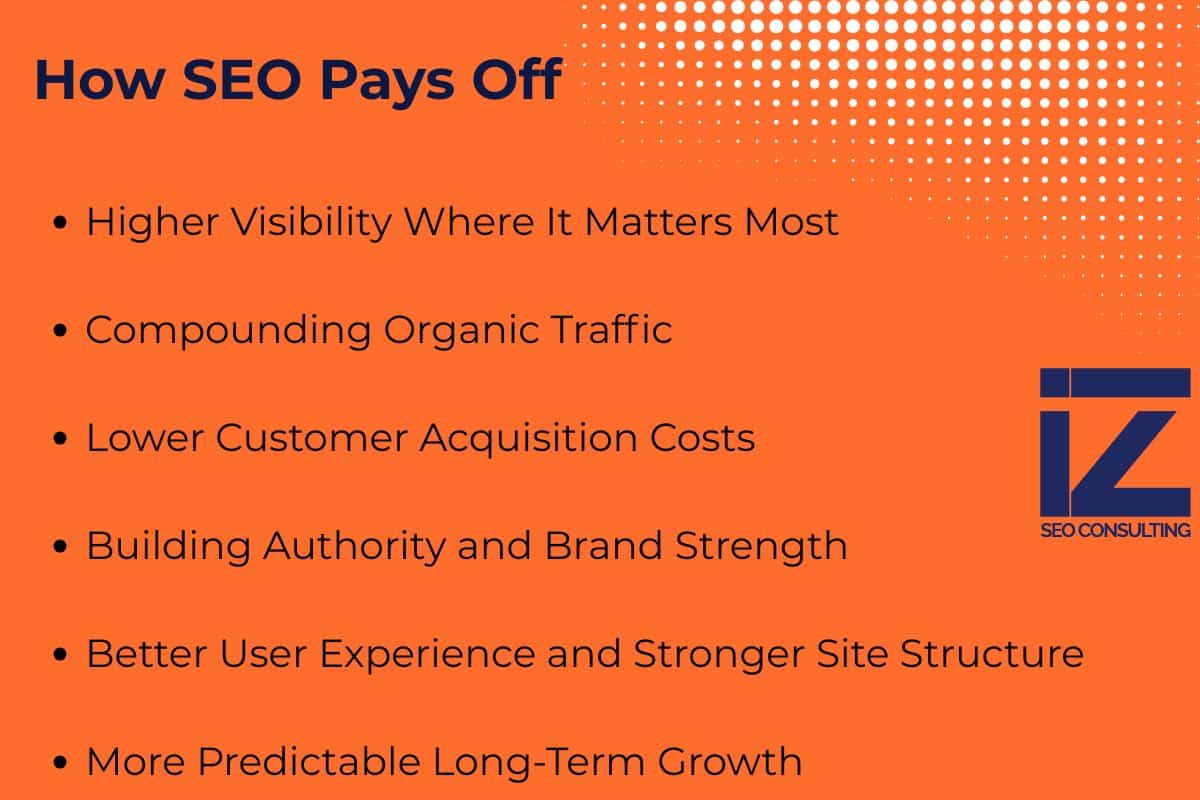
Higher Visibility Where It Matters Most
People search for answers on the internet. Problems compared to solutions, or decisions that need to be made, they will invariably search for answers. Because of that, search engine marketing is unique. You do the work once, and the results continue coming in for months or even years.
It’s the reason why serious businesses rely on services like Indexed Zone SEO to get their initial rankings.
Compounding Organic Traffic
SEO is a long-term strategy, unlike paid ads. A paid campaign gives a website a spike in traffic witch is useful for a quick boost, but once you stop paying, the traffic stops. That’s not the case with SEO. The more pages you optimize for search, the better the results become.
Once a website ranks for a sufficient number of keywords, Google treats it as an authority in a specific niche, and traffic follows as a result. Once that authority status is achieved, organic rankings consistently outperform paid advertising.
Lower Customer Acquisition Costs
Optimized pages will long-term outperform paid advertising. SEO builds an audience and increases traffic faster than most people expect. This is where the initial costs of SEO fade, and the SEO ROI begins to outgrow paid advertising spend.
Building Authority and Brand Strength
Your ranking is a reflection of your trustworthiness. Brands ranked higher are trusted more. That trust influences site visits, positioning, the ability to charge a premium, and how customers perceive you before they ever visit your site.
This is why so many companies invest in SEO: it boosts visibility and creates a self-reinforcing cycle of trust and exposure. You can see exactly how SEO strengthening your brand plays out in practice.
Better User Experience and Stronger Site Structure
Google rewards sites that load quickly, work well on mobile, and deliver information to users without friction. These improvements help real users stay longer, engage more, and complete desired actions.
This is why guides on search engine positioning consistently emphasize site structure as a core factor in maintaining long-term rankings.
More Predictable Long-Term Growth
Other marketing strategies are not as predictable as SEO. When executed properly, sites maintain their ranking even in the face of major Google updates. Well-built sites hold their ground.
SEO is one of the few marketing investments that becomes less risky as time goes on.
Driving SEO Results
There is no single thing that will dramatically improve your SEO on its own. Multiple components have to work in harmony to maximize your website’s potential. Understanding what each element does is how you build a lasting framework instead of blindly guessing your way through it.
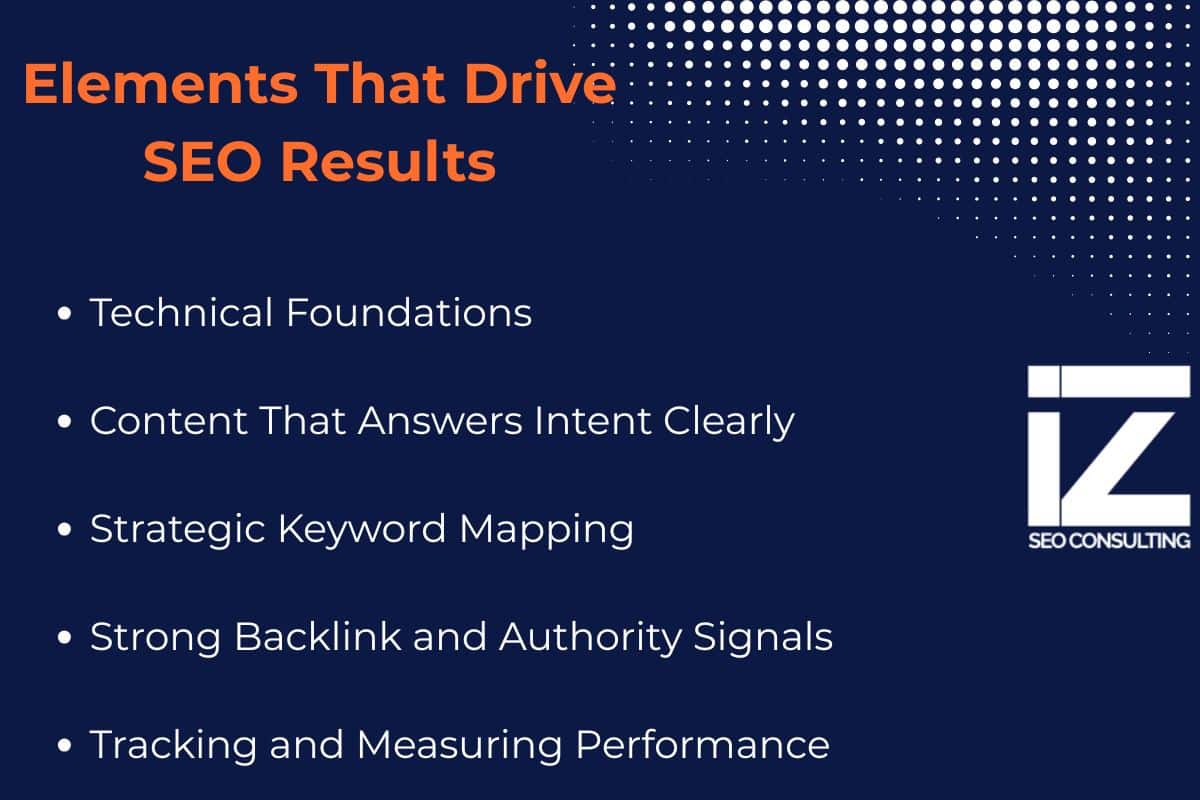
Technical Foundations
Your site’s technical health matters more than most people realize. Doesn’t matter how good your content is if search engines can’t properly crawl and understand your pages.
The essentials include:
- Crawlability – Can bots access everything they need to see?
- Site speed – Does your site load in under three seconds?
- Mobile-first performance – Does it work perfectly on phones?
- Clean internal linking – Can users and bots navigate easily?
- Proper indexing – Are the right pages being indexed and the wrong ones blocked?
Get these right and you naturally unlock stronger benefits of SEO for website authority and ranking stability.
Content That Answers Intent Clearly
Search engines measure one thing above all: Does your content satisfy what the user was actually looking for? Most sites fail here because they write for robots instead of humans.
Effective content does this:
- Gets straight to the point
- Uses plain language anyone can understand
- Shows real expertise, not generic advice
- Includes examples people can actually use
This clarity creates engagement. People stay longer, click around, come back. Those signals tell Google your content works, which pushes your rankings higher and multiplies the seo benefits for website visibility.
Strategic Keyword Mapping
Publishing random content whenever you feel like it rarely works. Each page needs a clear purpose, so Google knows which one to rank for which topic. When your structure is intentional, everything becomes easier to rank.
Proper mapping prevents you from competing against yourself and maximizes the strength of each individual page.
Strong Backlink and Authority Signals
Links still matter. A lot. But it’s not about quantity, it’s about relevance and trust. Good outreach, digital PR, industry connections, and genuinely useful content will earn you links naturally over time.
Quality backlinks also speed up the compounding effect behind the benefits of SEO for website growth curve.
Tracking and Measuring Performance
You can’t improve what you don’t measure. Traffic patterns show you what’s working, where people drop off, and which changes create the biggest gains.
Tools that focus on SEO metrics help you actually understand what the numbers mean. Not just rankings, but click-through rates, engagement, conversions.
Common Pitfalls and Misconceptions
Many website owners misunderstand SEO and look for a fast, simple path to results. That expectation leads to wasted budget or shortcuts that end up doing more harm than good.
Believing SEO results are quick is a common mistake. Search engines need time to scan and process updates made to web pages. Expecting new business within two weeks of making changes leads to frustration. Publishing without a plan is another blog post that doesn’t speak to real user questions don’t generate meaningful traffic. Google doesn’t reward length; it rewards usefulness. Buying links is a serious risk. Purchased links can eliminate your ranking position and trigger manual or algorithmic penalties that take months to recover from. And disregarding user experience undermines everything else. Google monitors user behavior closely, and a poor experience cancels out even well-optimized content.
Real Examples of How SEO Delivers Long-Term Value
Imagine a business that consistently puts proven strategies to boost your organic traffic into practice. They publish helpful content, traffic is slow for the first few months, then more pages start ranking. Before long, the business appears in high-intent searches dozens of times a day. Leads and sales increase. Work done six months ago is paying dividends on autopilot.
Consider a local service company as another example. They improve their site architecture, fix crawl errors, and organize pages around user intent. Within a few months, organic leads double because the business now shows up for the searches that actually matter.
This is why the SEO benefits for website growth go so far beyond improved rankings. They affect every step of the sales cycle, enhance brand reputation, and positively shape how customers perceive and trust the company, all in ways that are measurable.
Pro Tip: The Internal Link Cluster Signal
Most SEO documentation passively mentions content clusters, but few explain the mechanics behind why they work. When pages are internally linked to each other with no topical overlap, Google treats that cluster as a unified subject-matter authority and increases the collective ranking of the group, even if only one or two pages have external links pointing to them.
It’s one of the most impactful things you can do for the benefits of SEO for website architecture, and the most straightforward method for growing domain authority without heavy outside promotion.
Why This Works
The more tightly internally linked an article cluster is, the stronger the contextual signal Google receives. When a cluster focuses clearly on one topic, the algorithm can rank each page in that group more confidently. This consistently outperforms random, unstructured publishing.
The optimal approach combines strategic content with efficient indexing and a clean site structure to maximize the benefits of SEO for website growth.
Why Blogging Still Matters for SEO
Some people say blogging is over. They’re wrong. Blogging remains one of the most effective ways to drive organic traffic growth for most businesses.
The benefits of blogging about your website SEO strategy include more organic search entry points, increased topical authority, greater keyword coverage within your niche, and more opportunities to earn quality links naturally. When done consistently and strategically, every post strengthens the entire domain, not just the individual piece.
FAQ
Most sites see initial movement within 60 to 120 days. Real improvements usually show up after six to twelve months, depending on competition and your site’s history.
Absolutely. Small sites often win faster because there’s less to optimize and you can pivot quickly based on what works.
Yes. High-quality backlinks remain one of the strongest ranking factors. But quality beats quantity every time.
Not completely. They work best together. SEO gives you long-term stability while ads offer fast testing and immediate visibility.
Start Using SEO
Of all marketing strategies, SEO offers one of the most favorable returns on investment. Once you’ve built a solid technical foundation, created people-focused content, and established consistent signals, the long-term SEO benefits for website stability and growth are hard to match.
The most efficient path forward is to fix the gaps in your technical SEO, build purposeful content, and stick to what’s proven to work. The changes you make today will pay dividends for years, not just weeks.
Full SEO audit, keyword mapping, and complete content strategies are all available. Just reach out if you’d like help with the next step.