SEO is an important part of the internet ecosystem. When done correctly, SEO can dramatically improve a website’s visibility, drive targeted traffic, and increase conversions. However, many businesses and individuals often make basic SEO mistakes that can hinder their success. Therefore, let’s explore some of the most prevalent SEO mistakes as well as some of the biggest SEO mistakes and find some practical solutions for avoiding them.
Neglecting Keyword Research is One of The Common SEO Mistakes
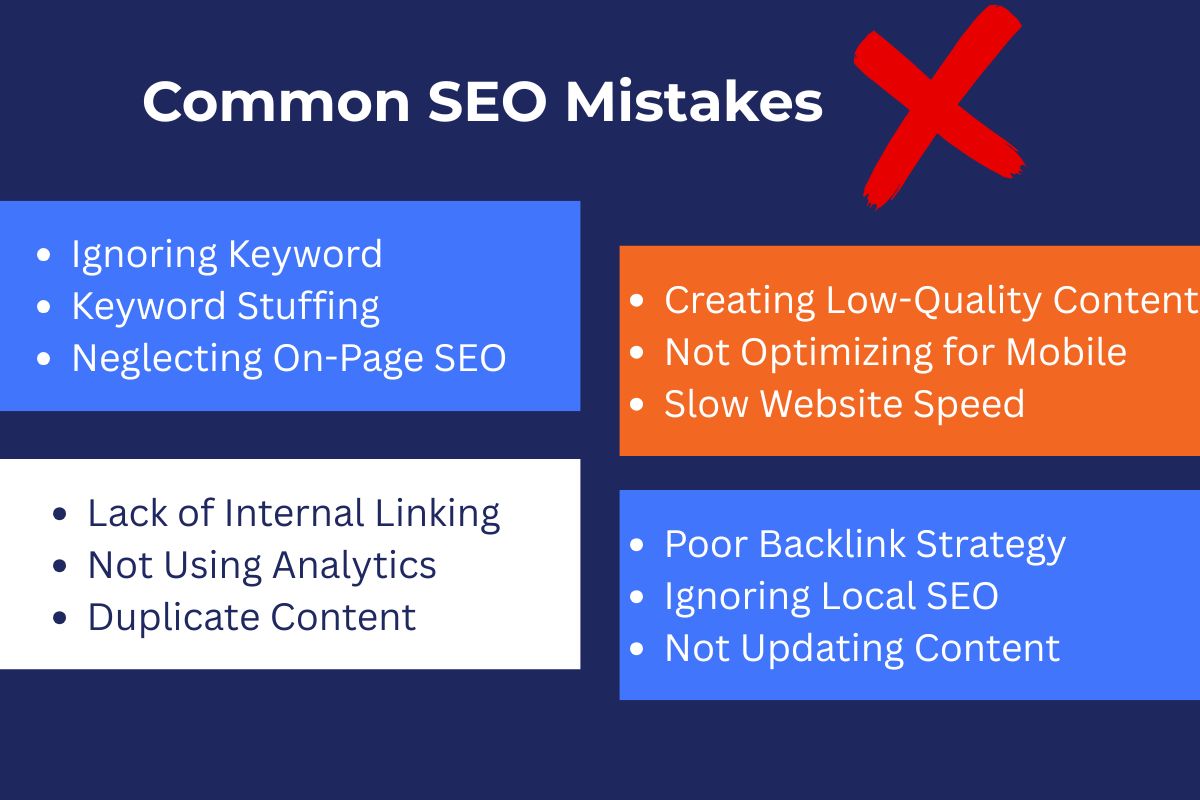
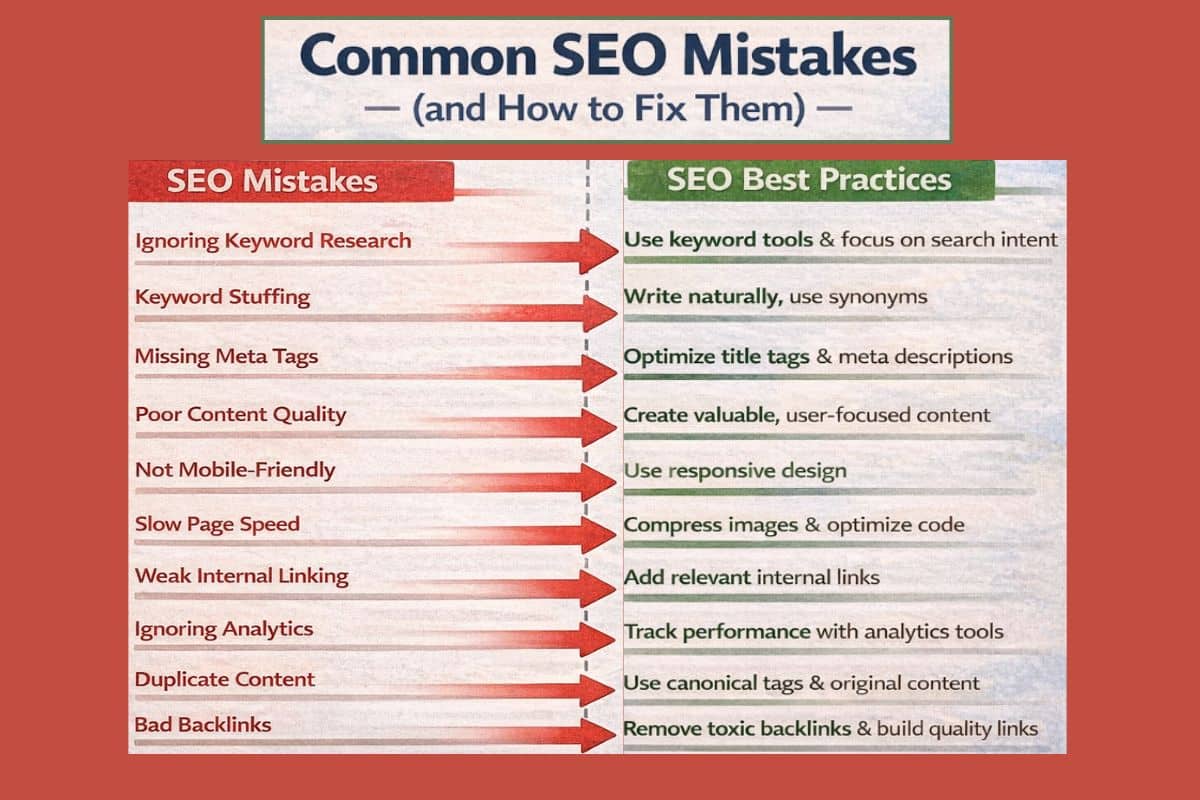
Neglecting the SEO keyword research process is one of the more common SEO oversights. Assuming to have an understanding of the queries generated by users is a common SEO blunder, as this is often the result of a lack of understanding of the predominant SEO research tools that are available. One of the common SEO oversights is not utilizing a range of available tools to determine the critical keywords. To align with more granular user intent, more focus should be placed on less common, longer keywords. The keyword strategy must be adjusted in accordance with the prevailing user search behavior trends.
Keyword Stuffing
When it comes to using keywords, although important, they can negatively impact your site ranking and usability. Rather than enhancing your site’s visibility, you can end up with an unintelligible site no one will visit, including Google. This is one of the fundamental mistakes of SEO. To avoid it, use keywords naturally and ensure they are incorporated into the context of the sentences. Google has shifted towards valuing relevance and readability more than sheer volume, so use primary keywords with synonyms, reader-related phrases, and secondary keywords.
Neglecting the Basics of On-Page SEO
You can limit your site’s visibility and discoverability by the absence of basic on-page elements like Title Tags, Meta Description, Headers, and Image Alt attributes. This can be solved by the following:
- Every page must have unique Title Tags and Meta Descriptions.
- Use HTML Header (H1, H2, H3) to organize and structure the content.
- Images must have relevant Alt Text.
- URLs must be concise and contain the main keyword.
Generating Poor Quality Content
One of the common pitfalls in content SEO is generating underdeveloped or poorly constructed content that does not add value to the consumer. Rubric-based content that is positively searchable will be evaluated. Content that is constructive, unique, and useful will be rated the best. Content that satisfies the users’ wants and needs through adequately resolving their problems and answering their questions will receive high value. Content creation is an expensive and time-consuming process, so it is best to incorporate high levels of firm writing and also integrate appropriate data, examples, and visuals to elevate its value.
Not Optimizing for Mobile Devices
With mobile traffic accounting for over 50% of all the traffic in the world, it is a bad SEO practice not optimize your site for mobile users. Therefore, try to have content that retains mobile users and utilize responsive web design so that your site can adapt to a variety of screen sizes. There are various tools that can help you evaluate the mobile usability of your site. Pay specific attention to text that is difficult to read and to pages that take a long time to load.
Website Loading Speed
People also make the mistake of having a site that loads slowly when it comes to SEO. It does not help users, and it also hurts the rating of the site. To improve it, try to:
- Shrink the size of your images while maintaining the same quality.
- Implement browser caching and content delivery networks (CDNs).
- Reduce the size of the JavaScript and CSS files.
- Select a web hosting company that is reliable.
Shortcomings of Internal Linking
Missing internal links indicate missed opportunities for indexing user paths and distributing authority. It is advisable to enrich your content with relevant internal links so that users can achieve their goals and increase their dwell time on your website. Provide internal links with descriptive text so users can preview the destination of a link.
Neglecting Analytics
A portion of website owners do not track their SEO performance, which is a missed opportunity to measure success and improve competitive ability for brand growth. Tools such as Google Analytics may be used to measure performance for a set of keywords and analyze the content’s structure. Monitor bounce rate, CTR, and session duration, and work toward improving your position for the target keywords to increase brand recognition.
Duplicated Content
Search engines get confused with duplicated content, which leads to penalties and lower rankings. Use canonical tags and document the original source for duplicated content. Regularly audit your website for content duplication and to ensure that each page contains original content.
Negative Backlink Strategies
There are also mistakes when it comes to SEO and link building. Not having sufficient high-quality backlinks and, worse, having purchased low-quality backlinks can hurt your site’s authority. Try to earn backlinks through guest post submissions, working with influencers, and building linkable assets. Softer techniques like link farms or buying links are black-hat SEO and should be avoided. Use tools to watch your backlinks.
Neglecting Local SEO
Local SEO strategies are avoided by businesses that have local customer bases, and thus, they are foregoing customers that are closest to them.
How to avoid it:
- Claim and enhance your Google Business Profile.
- Localize your keywords and add content based on your geographical area.
- Get citations and reviews from local businesses.
- Not Revising Content
In time, even the best content can become stale and lose importance. Reexamine older articles on a consistent basis to update information, enhance clarity, and incorporate new ideas. Google is more likely to see your site as relevant and lively when you are refreshing content.
FAQ
Neglecting the keywords is perhaps the biggest SEO mistake. Even if the content is good, with poorly chosen keywords, the content is unlikely to get sufficient traffic.
You should evaluate the effectiveness of your SEO strategy at a minimum once every quarter. More changes can be made in rapidly evolving industries.
Certainly. Most mistakes can be fixed with a reasonable amount of time and effort. Most lost rankings can be regained with the right strategy.
It’s not mandatory. Most SEO strategies can be implemented in-house with sufficient training and the right tools. An expert SEO consultant is often necessary when you’re dealing with a complex problem or highly competitive market.
It depends on the nature of the problem, as well as the level of competition within your niche. If the problem is insignificant, results can be expected almost immediately. On the other hand, more extensive corrective actions can result in site improvement within 3 months.
You can avoid the majority of common pitfalls by implementing basic strategies of prioritization and focusing on Google’s algorithms. Utilize SEO performance monitoring tools to avoid issues. Regularly check your website for SEO issues and improve it. Optimize your site for mobile devices and improve the user experience. Plan quality content and a content strategy. Apply on-page SEO techniques, and test your website for speed and functionality.
Most common SEO mistakes include:
Ignoring keyword research.
Making content too keyword dense.
Neglecting on-page aspects of SEO.
Publishing content that is of very low quality or duplicate.
Slow speed of the website.
Not being mobile-friendly.
Not having good backlinks.
Not using analytic tools.
Other mistakes include having too few internal links, failing to do localized SEO, leaving content outdated, and having dry content. These mistakes can be fixed to enhance your website and increase your ranking on search engines.
Conclusion
This is a quick overview of what is considered the basic and the biggest mistakes in SEO. These mistakes that have been stated are common but can be eliminated if there is a solid plan in place, a system that is monitored and maintained, and there is a commitment to best practices. Whether you are a small business, a blogger, or you work in marketing, understanding and avoiding these SEO mistakes is critical for your business to be successful. Indexed Zone SEO will help you avoid these mistakes and will help you stay on top of the trends in SEO. Your website will be in a position to enhance its visibility, the experience of the users will be improved, and you will be able to achieve growth that is sustainable.