In SEO, not every success needs to be a major struggle. Results that are rewarding in the long term are good as they are. Long-term strategies and focusing on the competitive keywords are important for every website, but a majority of the websites miss out on achieving some success, which could be a lot quicker, for example, low-hanging fruit keywords, which are not currently optimized to their full potential. Finding these keywords allows you to achieve a significant increase in the volume of traffic to your website, in addition to the positive effects on your SEO.
In this article, we explore the meaning of low-hanging fruit keywords, the methods of locating them, and the SEO strategies that will help you achieve the desired results once you have employed the identified keywords.
What Are Low-Hanging Fruit Keywords?
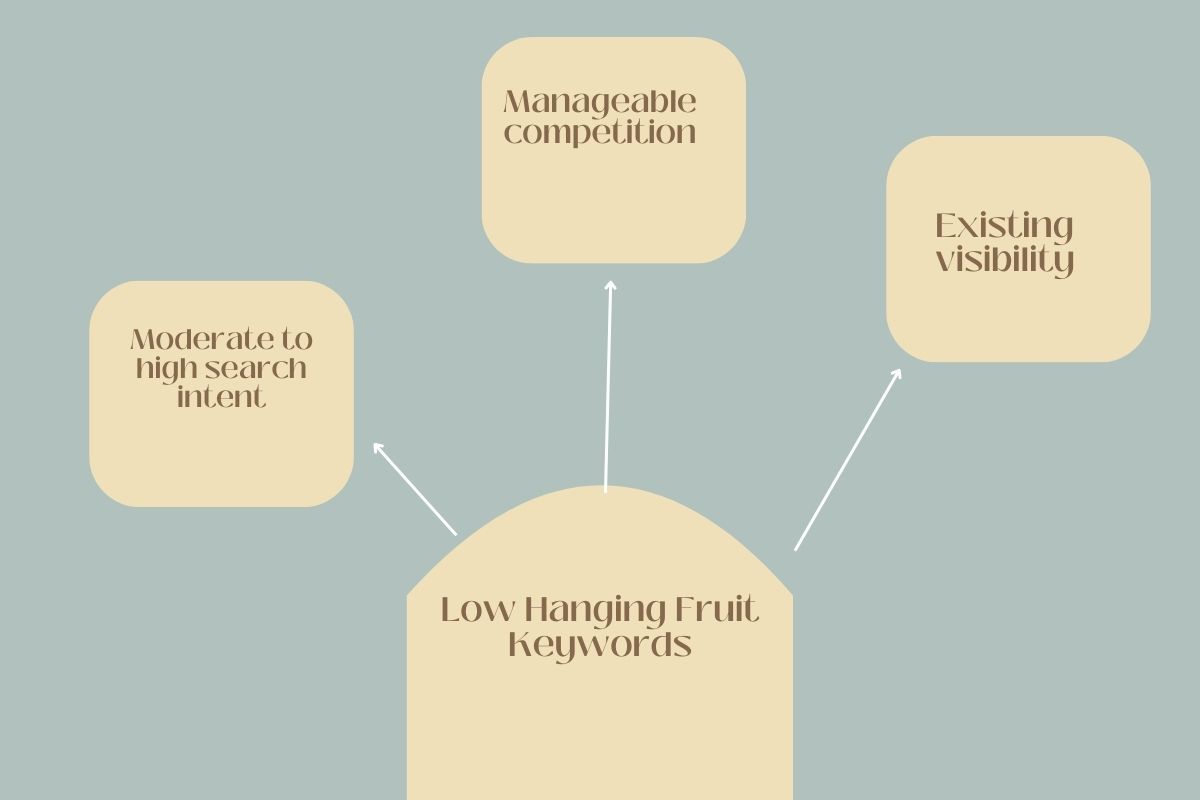
Low-hanging fruit keywords tend to be search queries where a website is already doing fairly well, but could improve further. These keywords might be ranking towards the bottom of the first page of Google results or the second page. This type of keyword visibility commonly includes:
- Moderate to high search intent
- Manageable competition
- Existing visibility, but low click-through rates or rankings
These keywords are less competitive compared to others that could take years to improve ranking for. Often, they just need some updates to the content or on-page SEO, and maybe a few technical adjustments. This offers a chance for a quick win in SEO.
Why Low-Hanging Fruit Keywords Matter for SEO
For smaller teams and developing websites, there are several benefits. They not only take less time and resources compared to newer keyword campaigns, but they also show that work done previously can be built on, so the process doesn’t have to start all over.
In terms of effectiveness, SEO keywords of low-hanging fruit are useful for building momentum. The better you rank and the more traffic you obtain, the more data, authority, and confidence you possess to go after more competitive terms later on. This is how IZ SEO consulting, as well as many agencies and consultants, utilize this method for building trust with their clientele.
Where to Find Low-Hanging Fruit Keywords
In order to find these instances, one must examine the data on hand. The data must be analyzed instead of utilizing guesswork to determine the keywords that are likely to be successful.
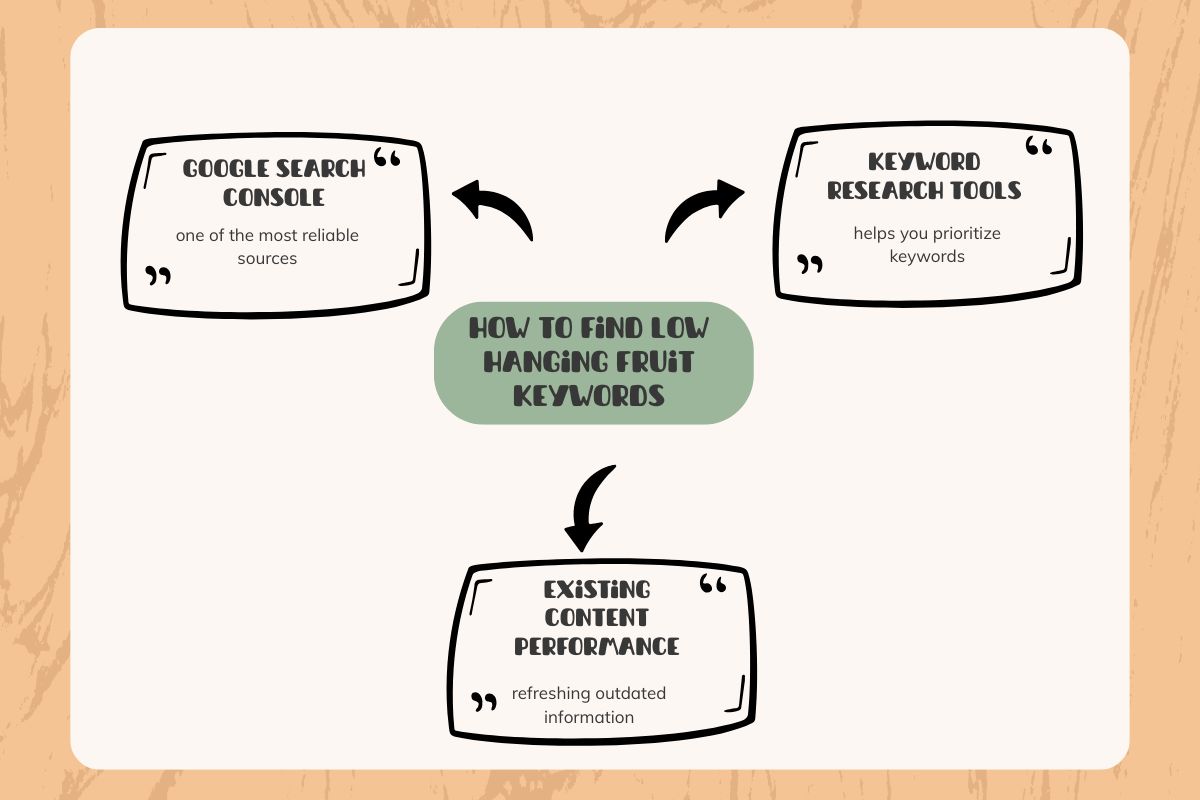
Google Search Console
Google Search Console is one of the more dependable sources for collecting low-hanging fruit keywords. Search for the following queries:
- Your pages rank between positions 8 and 20
- Impressions are high, but clicks are relatively low
- Small ranking improvements could significantly boost traffic
This is Google demonstrating that it has a fair amount of trust in your content, yet users are not engaging with it, and your ranking could use a boost.
Keyword Research Tools
Research tools like SEMrush and Ahrefs can assist you with refining your data. Compare Search Console data with metrics of keywords in order to determine difficulty and volume for a given period. This is one of the steps that would naturally fit within the context of an overall SEO keyword research initiative, as it enables you to focus on the keywords that are likely to produce the best results for the least amount of work.
Existing Content Performance
Out-of-date information, poorly written structure, or a failure to meet search intent may prevent a blog post or landing page that has previously ranked highly from sinking lower in the rankings, becoming a goldmine to be refreshed for low-hanging fruit keywords.
Evaluating Search Intent and Competition
Not all keywords that appear on page two of rankings are actionable to be targeted. It is important that the search intent be accessible, properly aligned, and that the page contains the relevant information to answer the question contained in the search query.
In addition, review the relevant search results that are ranked in the top position. In the event that the results contain well-established authors and highly comprehensive content, the keyword may be more challenging to rank for; such keywords may not be a low-hanging fruit. Conversely, if the results contain pages of varying quality that do not contain a lot of information, discussion forums, or are stale content, this is an excellent opportunity.
This observation encompasses the relevance of content, quality of the page experience, and quality of the backlinks, which are all important to rank.
How to Optimize Content for Low-Hanging Fruit Keywords
After determining the keywords that you wish to target, the optimization phase results in the greatest potential for improvement. In most cases, minor enhancements may lead to a significant improvement in ranking.
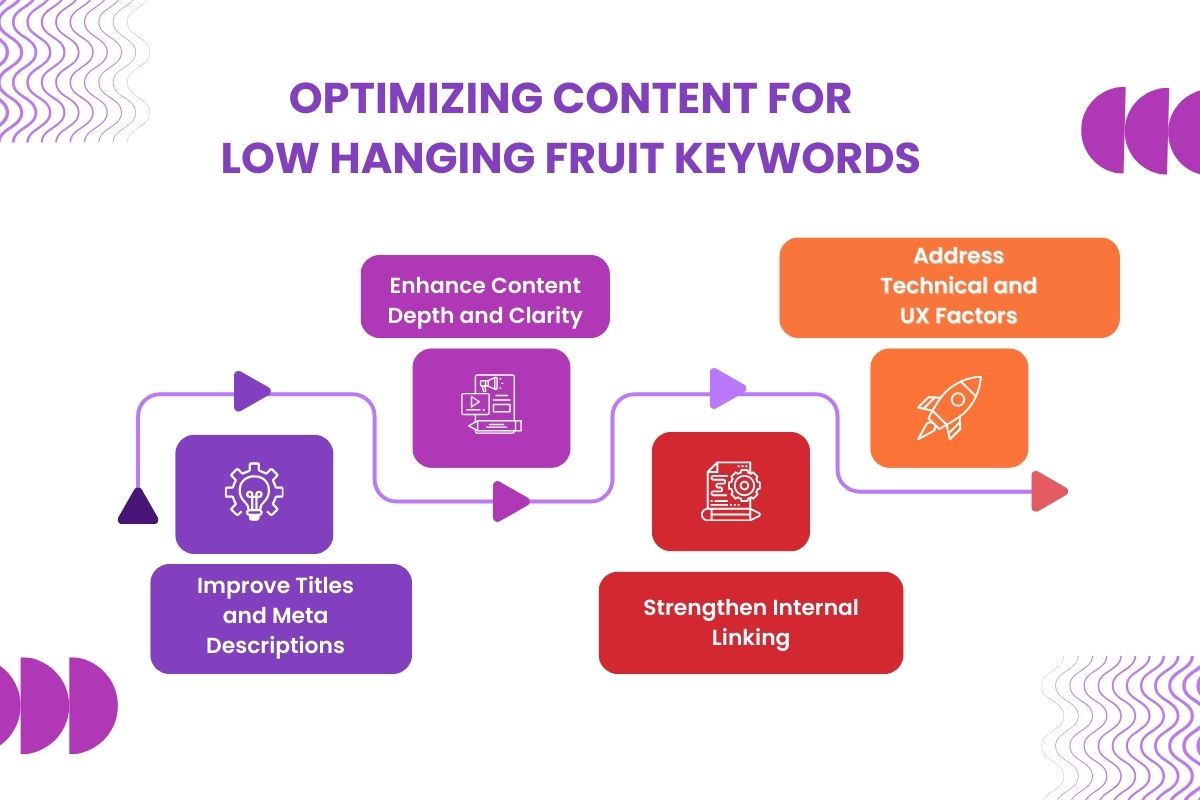
Improve Titles and Meta Descriptions
Pages with high impressions and low clicks might not be seeing drive traffic due to poor messaging. Titles and meta descriptions may be rewritten to reflect user expectations and clarify the value of the content. This leads to greater click-through rates.
Enhance Content Depth and Clarity
Enhance the clarity and detail of sections. Content may be improved by answering relevant questions, providing examples, adding statistics, and improving overall readability.
Strengthen Internal Linking
Internal linking increases the Web Content Accessibility Guidelines (WCAG) and helps search engines identify content clusters and value equilibrium. Use relevant articles to link to your optimized page using low-hanging fruit anchor text.
Address Technical and UX Factors
Technical performance undercuts great content. Ensure your pages are mobile-friendly, load quickly, and provide an overall good experience. Simple optimizations, like image compression or enhancing your site for mobile, can support ranking improvements.
Measuring Success and SEO Metrics
Analyzing performance before and after an optimization action is always important in order to confirm that your efforts were justified. Review position changes, overall visitors gained from search engines, and the click-through rate in the search result listing. Consider average position, how many times your URL was displayed to a user, and the behavioral engagement metrics, among other things.
Since just about every low-hanging fruit keyword should show results fairly quickly, it is reasonable to expect to see changes in a few weeks rather than several months. These initial positive results will provide the information necessary to improve your other results through scaling to additional pages.
Situations You Should Avoid
One possible situation would be a lack of an audience to search and find your results; thus, there would be no real value in a keyword, no matter how easily it can be ranked. Another condition would be to exceed the suggested number of times that a keyword can be used, and therefore make the content more difficult to read.
Neglecting results should be avoided as well. An increase in ranking is a good thing, but it means very little if the new results are for the wrong audience. Ensure that your goals are aligned and set the keywords that will provide results to your audience.
Scaling Low-Hanging Fruit Keywords into a Long-Term Strategy
Looking at low-hanging fruit keywords, they are the beginning of your long-term SEO goals, not the end. When your site starts acquiring authority and traffic, the landscape of opportunities will begin to shift. Pages that once settled for bottom-tier rankings may dust off the competition and jump to the next tier with the right quick win strategy.
This balance allows you to maintain short-term wins with the traffic boost proven strategy integrated to support your long-term plan.
Conclusion: Using Quick Wins to Maintain Momentum
Apart from being one of the most time-efficient methods of explaining and gaining SEO, low-hanging fruit keywords have the most potential to drive visibility to your site and drive efficiency to the SEO goals you have set. In short, the right, low-hanging fruit SEO keywords and moderate amounts of time should yield quick wins and drive even larger goals.
When setting your sights on the competition, do not target the highest, most distant goals. Start within the horizon to identify the achievable goals that can drive progress to the next set of high goals. Those small improvements can add up to meaningful growth and create the momentum needed for long-term success.