If you have spent time on organic traffic growth, you have likely seen the advice to create content over 1,500 words. It is seen as an easy solution, but it is an over-simplification of a specific rule in content marketing.
The best SEO content length depends on what a person is searching for, the topic’s competition, and the overall complexity of the topic. While word count is a component of SEO, it is the context that matters.
This guide is designed to give you a solid overview of developing your content length and highlight where SEO content writing is misunderstood the most.
What Is the Best Content Length for SEO?
No length guarantees a search engine to place the page; the best content length for SEO is as many words as are needed to answer the question in the search.
That said, patterns from real search results are useful as a starting point:
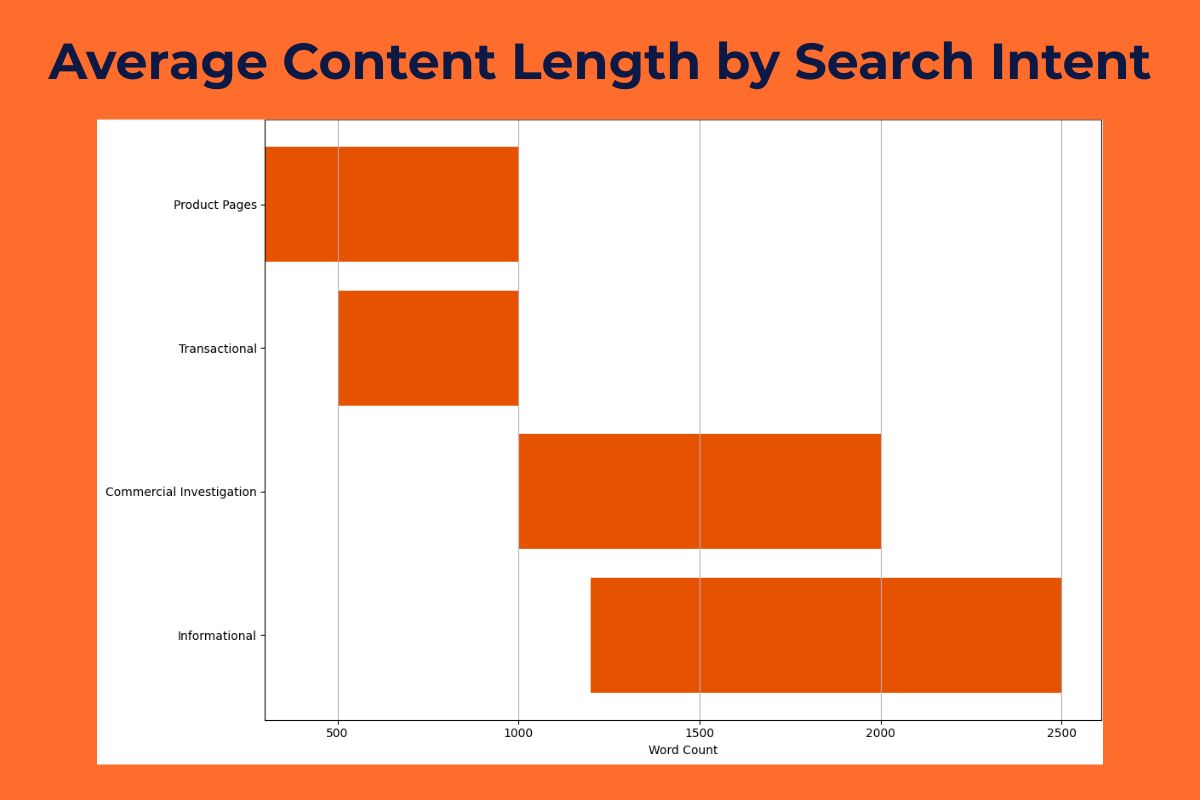
- Blog posts ranking on page one tend to fall between 1,200 – 2,500 words
- In-depth competitive guides often push past 2,000 words
- Transactional landing pages can rank comfortably at 500–1,000 words
- Product pages sometimes rank with even less, if the domain already carries authority
Search engines aren’t rewarding length; they’re rewarding completeness. Longer articles often outperform shorter ones simply because they tend to cover a topic more thoroughly. But those are two different things.
So when people ask what is the best content length for SEO, the smarter question to ask yourself is: how much does this specific query actually require?
Three quick examples:
- “How to tie a tie” → a few clear steps, done
- “Complete guide to technical SEO” → real depth is expected
- “Buy red running shoes size 10” → clarity matters, not word count
Intent shapes length. Always.
Why Longer Content Often Performs Better
The correlation between longer content and stronger rankings is real. But it’s worth understanding why, because without that understanding, people start padding articles for no reason.
1. More Opportunities for Keyword Coverage
A longer article naturally touches on related phrases, supporting concepts, and subtopics. That breadth reinforces topical relevance.
A 2,000-word piece on “email marketing strategy” will almost certainly mention automation, list segmentation, open rate benchmarks, deliverability, and tool comparisons. A 600-word version probably hits two or three of those, at best. Search engines pick up on that difference.
2. Readers Stay Longer
Comprehensive content gives people a reason to stick around. While dwell time itself isn’t a confirmed ranking signal, strong engagement patterns correlate with pages that perform well over time.
3. Better Chances of Earning Backlinks
Detailed, well-researched content gets cited. It becomes a reference. Thin posts rarely do.
None of this justifies stuffing articles with empty paragraphs. Padding to hit a target word count is one of the fastest ways to tank engagement, and it’s a habit worth breaking early.
How to Find the Best Article Content Length for SEO
The most reliable method isn’t a formula. It’s looking at what’s already winning for your keyword and working from there.
Step 1: Look at What’s Actually Ranking
Analyze the first page for your desired keyword:
- What is the average content length?
- What type of content is on the page?
- What keywords does the page rank for?
- Are backlinks established for the content?
Step 2: Map Out the Subtopics
Analyze the pages to create the best ranking content. The pages are your best example.
- “People Also Ask” sections in search results
- Related searches show up at the bottom of the page
- Headings within rival articles
This indicates how much coverage your audience anticipates. Careful planning with the appropriate keywords is crucial here. A methodical approach, like the one in this SEO keyword research guide, outlines the scope of the topic before you put pen to paper.
Step 3: Match Length to Intent
Not every query warrants the same approach.
- Informational Queries – Typically 1,200 – 2,500 words. These benefit from depth, obvious structure, and well-thought-out subheadings that tackle subsequent questions.
- Commercial Investigations – Generally, 1,000 – 2,000 words. Readers are weighing alternatives, so valuable comparisons and genuine pros and cons are very influential here.
- Transactional Queries – Generally, shorter. The reader is already decided. Concise and assured writing is more potent than sheer volume.
Getting this correct saves you from excessive content on pages that don’t require it, and insufficient content on pages that do.
When Shorter Content Actually Wins
In the SEO community, there is a strong tendency to always write more. This has resulted in a great deal of unnecessarily bloated content on the internet.
Shorter pages may perform better than longer ones when:
- The question has a clear, narrow answer
- The site already has a strong domain authority
- The intent of the page is not to inform, but to convince
- The subject matter lacks important and meaningful subtopics
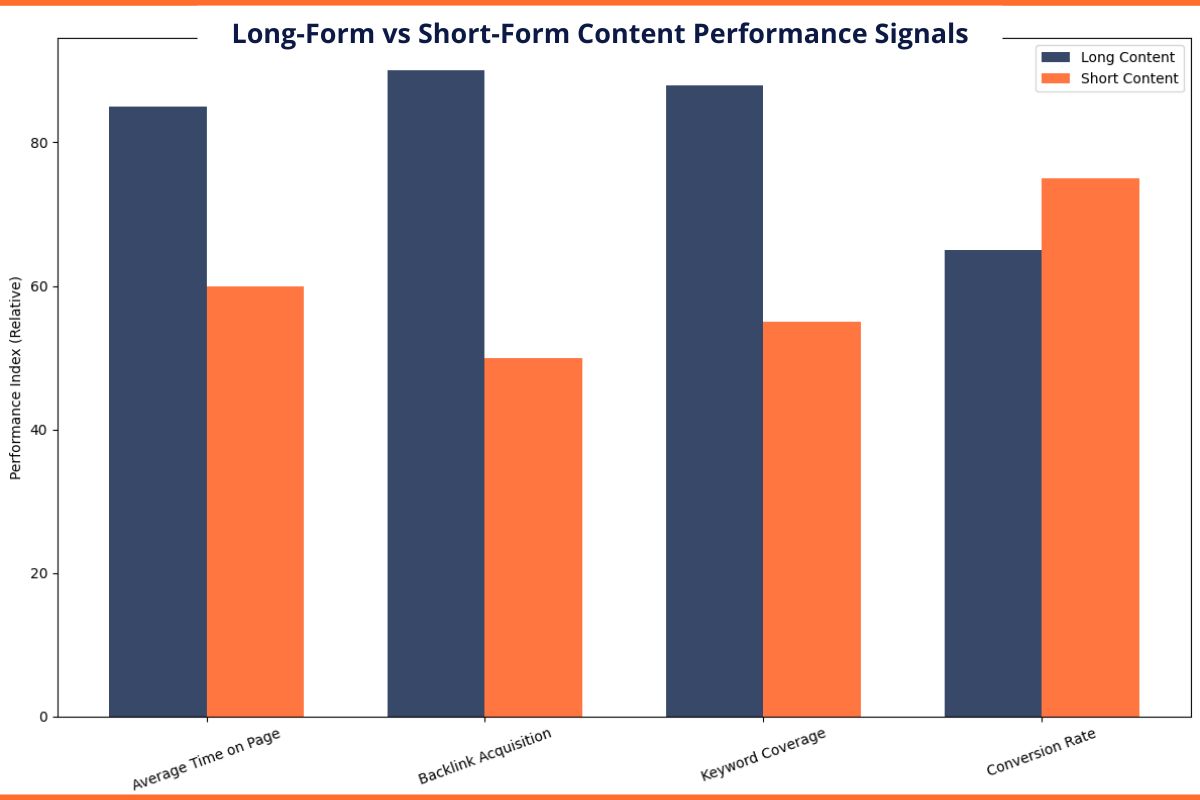
A concise 800 word service page, that is clear and to the point, will outperform a 2,500 word page that buries the key information in a frustrating, and lengthy context. We’ve all heard the saying, “The clearer, the better”. Additionally, excessive word count is not a contributing factor to SEO ranking metrics. This has been consistent with Google SEO guidelines. Content that is helpful will rank, while lengthy, unhelpful, and verbose content will not rank due to its unhelpful nature.
Mistakes When Targeting Specific Word Counts
Many websites misinterpret the content length best practices leading to unnecessary issues for themselves.
Filler to Reach a Target Count
Readers notice content that has been unnecessarily stretched, repetitive, or padded with background/contextual information that is irrelevant to the point. When that happens, sites will lose readers and thus hurt their rankings.
Ignoring the Query’s Intent
Mass publishing content without considering the actual query’s intent. These guides, regardless of their level of writing, will be useless. There are many guides, that are well written, with a lot of effort put into doing them and go unnoticed and the author will struggle.
Publishing Low Value Content
Other websites may be producing hundreds of low value content and expect a return. Low value content will provide them with negative value content. In efforts to produce a lot, they lose the value of their content.
There are many issues when teams miscalculate or mismanage content length.
Screens Over Count
Search engines primarily focus on value and topical coverage, and do not reward sites that produce large quantities of content.
One clearly established, focused 1400-word article that provides complete answers to every relevant question within its scope can easily outrank a 2800-word article that rambles, with little to no focus on the actual intent behind the article—coverage over scope.
The fundamental principles of competitive content include:
- Coverage of related topics and concepts in a coherent and cohesive manner
- Structured headings that guide and direct the reader’s thought processes
- Specific evidence in the form of data, real world examples, and plausible use cases, as opposed to vague and general statements
- Updating content as search behaviors change

Consider SEO tools. General and broad overviews become forgettable. Actual semantic authority is built when a specific focus is given in deeper analyses, including categorization, pricing comparisons, and real world use cases.
This provides the basis of how to create search-optimized content that doesn’t just rank once, but builds on lost visibility and revenue in the future. Your organic traffic growth, keyword data, and user engagement over time, as well as your SEO data, determine the correct article length and data depth. These specific SEO data points transform what would be guesswork into a verifiable, actionable, and fully responsive feedback loop.
Real-World Benchmarks by Content Type
The patterns of different content types across different industries help us determine the optimal length of an ideal article for SEO.
- Blog Posts – 1,200 – 2,000 word counts are ideal for the most competitive niches. Blog posts should have enough depth to be useful to the reader, but should not be too lengthy that they lose interest.
- Ultimate Guides – 2,000 – 3,500 word counts are ideal for posts of content that are intended to create authority, power, and expand on a topic in a multifaceted manner.
- Service Pages – 800 – 1,500 word counts are ideal in contrast to the length of service pages that are less competitive. Services that are more nuanced may need more detailed explanations and descriptions.
- Product Pages – 300 – 1,000 word counts are ideal for those that have positive signals such as strong reviews, detailed specifications, and strong internal linking.
These observations are not rules set in stone. It all depends on the competition and how deeply the topic has to be addressed.
Does Google Prefer Long Content?
The straightforward and direct answer to this question is that Google prefers content that offers help.
Long content does well in terms of SEO primarily because it is well detailed and is able to completely satisfy the interest of the reader. But there are still many pages that are shorter that do well at the primary and most competitive keywords because they are able to clearly satisfy the interest of the reader.
Recent algorithm updates have moved towards content quality and clarity and actual user satisfaction, so the need for length for length’s sake has become even less relevant.
As such, if someone were to ask, “What’s the ideal content length for SEO?”, the honest answer is still “As long as it has to be to outdo what’s currently ranking in the first SERP.”
What this means is that instead of chasing an arbitrary number, there is a better process:
- For your target keyword, find the top 5 ranking pages. Look at the average length and how they are structured.
- Make a note of how in-depth they are in covering the subtopics and look for areas that you can improve on that are lacking content.
- Be tactful and go straight to the point, eliminating anything that may be distracting to the readers.
- Take note of the data, this is the ranking, rate of engagement, time spent on the page.
- When it looks like it is going nowhere, update it.
If you are able to surpass the target intent for the first page results, you have better content than everyone else and that is what you should be going for.
For businesses that are determined to achieve results, collaborating with Indexed Zone SEO can assist in avoiding the trial-and-error process by creating a seamless integration of strategic planning and result-driven operations.
Begin your analysis with your top-performing pages. Then, evaluate your top-performing pages against your competitors. Where there is a true gap, make adjustments, and then observe the changes.
SEO is about accuracy, not generalization.
FAQ
SEO is not concerned with ideal content length. Currently, the most strongly competing content is around 1,200 to 2,500 words, and this is the length to aim for. However, this will also differ depending on search intent and what is currently ranking for the specific keywords.
It is possible, especially for low competition and specific keywords. However, for highly competitive and broad topics, 1,000 words is most often not sufficient to compete.
Definitely. Content that is longer than what the reader actually wants results in a loss of focus, lower conversion rates, and an increase in bounce rates. More words is not always advantageous.
Google does not punish short content. Google examines the usefulness of the content. If the content is short and answers the question fully and clearly, it will be ranked.