Comparing today’s Google search results to those of five or ten years ago reveals how much Google has changed the way it responds to different queries. Search engines used to provide the same results to the same queries, without regard to the individual user’s context. By customizing search results depending on user behavior, preferences, and context, Google has changed the way businesses think about their digital visibility, performance, and long-term positioning on search engines. Therefore, in order to remain competitive, marketers must understand how personalized search results impact SEO and how personalization modifies performance, rankings, and the focus of optimization. Consequently, we will detail how personalized search works, the significance of personalized search rankings, and how they impact SEO in the current landscape.
What Are Personalized Search Results?
The results of personalized searches are listings that differ in accordance with the individual user conducting the search. In contrast to relying on the same static ranking criteria, search engines use the following criteria to personalize search results:
- Search history.
- Location and device type.
- Language settings.
- Engagement behavior.
- Previous interactions with websites.
Consider the case of two users entering the same keyword in the search engine. Because of the personalization used by the search engine, they are likely to see different search results that have different relevance levels, utilizing the previously mentioned user data. Personalized search engines are always striving to improve user relevance and personalize their listings to improve user satisfaction.
How Personalized Search Ranking Works
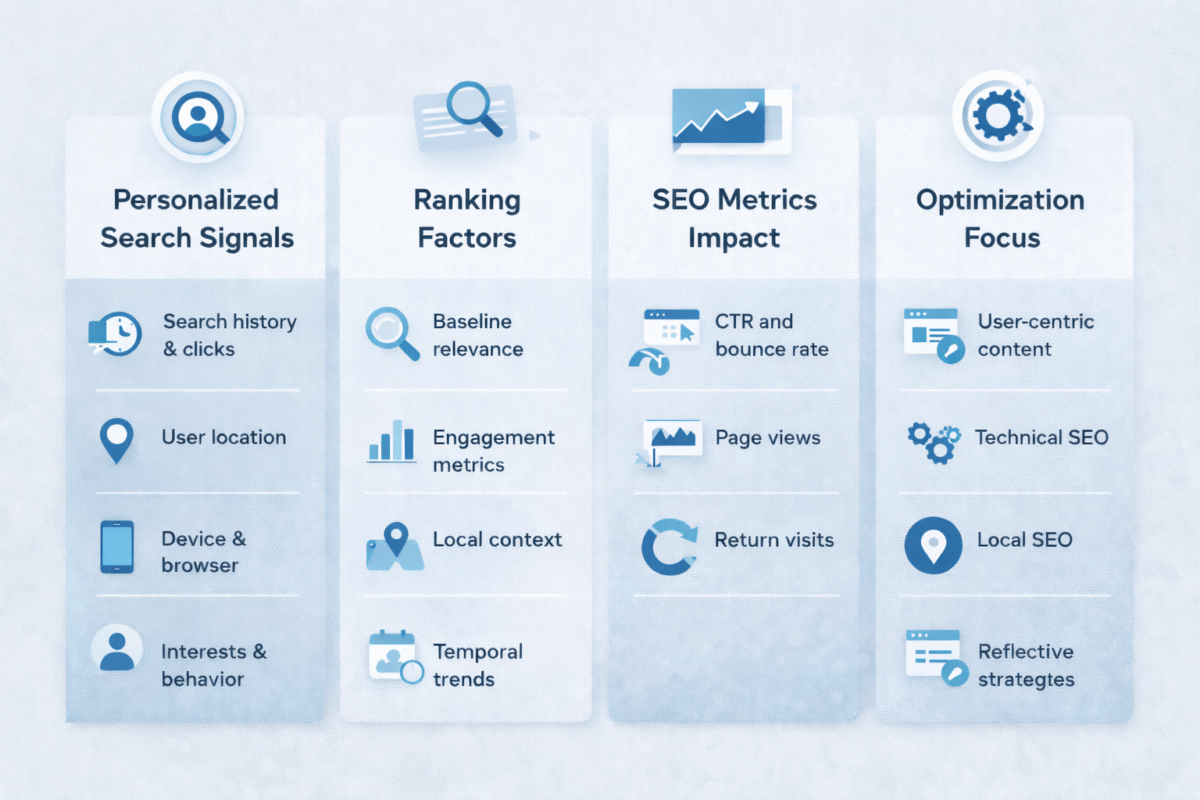
Due to the personalization layers that search engines apply to standard ranking systems, it is safe to say that Personalized Search Ranking is more likely to be used as the basis for research queries that involve search engines. Core ranking factors that remain unchanged include backlinks and content quality. However, the Personalized Search Ranking must adjust based on the user. Some key factors that drive personalization include the following:
- Search History – Pages a user previously visited may rank higher for them.
- Geographic Signals – Local intent heavily influences results, even for non-local queries.
- Device and Platform – Mobile users may see different results than desktop users.
- Behavioral Data – Click-through rates and engagement affect perceived relevance.
- Account Data – Logged-in users receive more customized results.

These layers of personalization of search results in absolute rankings that are almost nonexistent, and this impacts the performance of SEO to be more streamlined to the user than before.
Personalized Search Ranking and SEO Strategy
Educating oneself on personalized search ranking and the impact it has on the search process is essential, as each step is designed to achieve specific outcomes. Most importantly, SEO professionals should be intent on achieving a steady and consistent level of relevance across multiple user segments instead of pursuing a single keyword or phrase intended to achieve a ranking in that number one position. There is a direct impact on SEO as a result of the personalization of search results:
- Rankings fluctuate based on user behavior.
- Visibility becomes audience-specific rather than universal.
- Performance measurement requires broader data interpretation.
This emphasizes the need for mutual cooperation between SEO and UX. Meaningful experiences are what search engines aim for, rather than simply keyword spam.
How Does Personalized Search Affect SEO Performance?
It becomes difficult to gauge the impact since various factors are at play. Given that personalized search creates variability in search results for each query, typical rank tracking tools can offer averages, not absolute values. It becomes crucial to monitor search result trends, track user engagement, and optimize conversion rates, in addition to other important SEO metrics, rather than fixating on a specific keyword. Personalized search results mean SEO also encompasses the following analytical components:
- High-quality content may rank differently for different users.
- Brand familiarity influences visibility.
- User intent alignment matters more than exact keyword matching.
Ultimately, SEO success is more about sustained trust and authority and less about the ranking itself.
The Role of Ranking Factors in Personalized Results
Complexity is an inherent part of the modern SEO landscape. Yet the fundamental ranking factors that drove search visibility remain the same. Search engines evaluate all results based on a set of traditional ranking signals before applying a personalization filter. These signals can be:
- Content relevance and depth.
- Page experience and site speed.
- Backlink quality and authority.
- Mobile usability.
- Structured data and technical SEO.
These ranking factors are not special with respect to personalization. Instead, personalization is meant to complement and enhance them. Pages that are able to predict and satisfy user intent over the long term will be successful in all the personalized scenarios.
Personalized Search, SEO Metrics, and Measurement Challenges
Because personalized search results SEO varies by user, measuring performance takes a more extensive approach. Instead of relying solely on ranking, marketers focus on a wider set of SEO metrics. Important metrics include:
- Organic traffic growth.
- Click-through rates (CTR).
- Engagement metrics (time on page, bounce rate).
- Conversion rates.
- Search visibility across devices and locations.
Even if ranking differs, these metrics help tell the story of how effectively a site meets the different needs of the users.
SEO and UX: Why Personalization Rewards Better Experiences
Personalization strengthens the relationship between SEO and UX. Search engines reward the site where audiences spend time, come back, and trust.
To strengthen SEO and UX together, focus on:
- Clear navigation and intuitive structure.
- Fast load times across all devices.
- Content that answers real user questions.
- Logical internal linking for easier discovery.

When users find value quickly, search engines interpret that behavior as a relevance signal, improving personalized search ranking outcomes over time.
How to Optimize for Personalized Search Results
Although you cannot manage personalization directly, you may optimize for personalization by building relevance, trust, and consistency. Here’s how this can look in practice:
- Create intent-driven content that serves different stages of the buyer journey.
- Improve technical SEO to ensure accessibility and speed.
- Clarify context by using structured data for search engines.
- Focus on brand authority through consistent publishing and outreach.
- Optimize for engagement, not just rankings.
If you want to improve your online presence, Indexed Zone SEO helps you build a solid foundation with tried and true on-page SEO techniques aimed at contemporary, user-centered search.
The Future of Personalized Search and SEO
As AI and machine learning become more sophisticated, personalization is more refined. Search engines will rely more on behavioral data, real-time intent signals, and contextual relevance. As a result, SEO strategies will need to:
- Adapt to audience segmentation.
- Prioritize quality over shortcuts.
- Align content, UX, and technical performance.
In the future, businesses that prioritize and invest in sustainable relevance will be the most rewarded as search engines continue to personalize the way they rank businesses.
Convey concept to users
The advent of personalized search results has deeply intertwined shifts in SEO processes. Instead of pursuing anticipation of steady rankings, companies search for indicators of relevance, engagement, and user satisfaction. Adopting, measuring, and customizing personalized search ranking, UX, and SEO frameworks help companies maintain and improve brand health in a dynamic, personalized search environment. Achieving success means valuing users more than simply valuing automated processes.
FAQ – Frequently Asked Questions
As a result of personalized search ranking, search results can differ due to factors such as user behavior, geolocation, device, and search history.
It forces a focus on user intent, engagement, and relevance rather than on rigid keyword targets.
No, search results are beyond our control, but you can optimize for search results by focusing on improving your content, user experience, and technical SEO.
Most search engines’ primary objective is to maximize relevance by customizing search results based on each user’s unique attributes.
Absolutely. Established ranking factors, such as link building and content quality, remain pertinent.
Although there is still some merit in tracking rankings, focus more on traffic, engagement, conversions, and visibility trends.
More effective user experience (UX) generates more positive engagement signals, which improves personalized visibility.