Search engine visibility is something that can be given to you, but it can also be taken away. A lot of business owners don’t realize how fragile that visibility can be.
What’s the problem? When you stop SEO, nothing breaks immediately. The traffic doesn’t suddenly disappear. The drop is gradual, and in a lot of cases, almost undetectable. It seems like, for no particular reason, the owner is staring at the analytics, and the numbers just don’t add up. Competitors are gaining ground. Revenue follows. Most of the time, by the time business owners notice something is wrong, the damage is already done.
That’s why understanding what happens when you stop SEO matters so much. It’s not a campaign you run and finish; it’s an ongoing process, and the importance of ongoing SEO maintenance for businesses only becomes clear once that process has stopped.
What Happens When You No Longer Do SEO?
In short: your search rankings fall, your traffic levels drop, and your competitors take your spot.
But the detailed answer is far more complicated than a simple three-step summary.
Search engines are continuously changing their algorithms. Your competitors are constantly improving. Unattended technical issues pile up in the background. The web surrounding your stagnant site keeps moving, and your website gets left behind.
Here’s how that looks in practical terms.
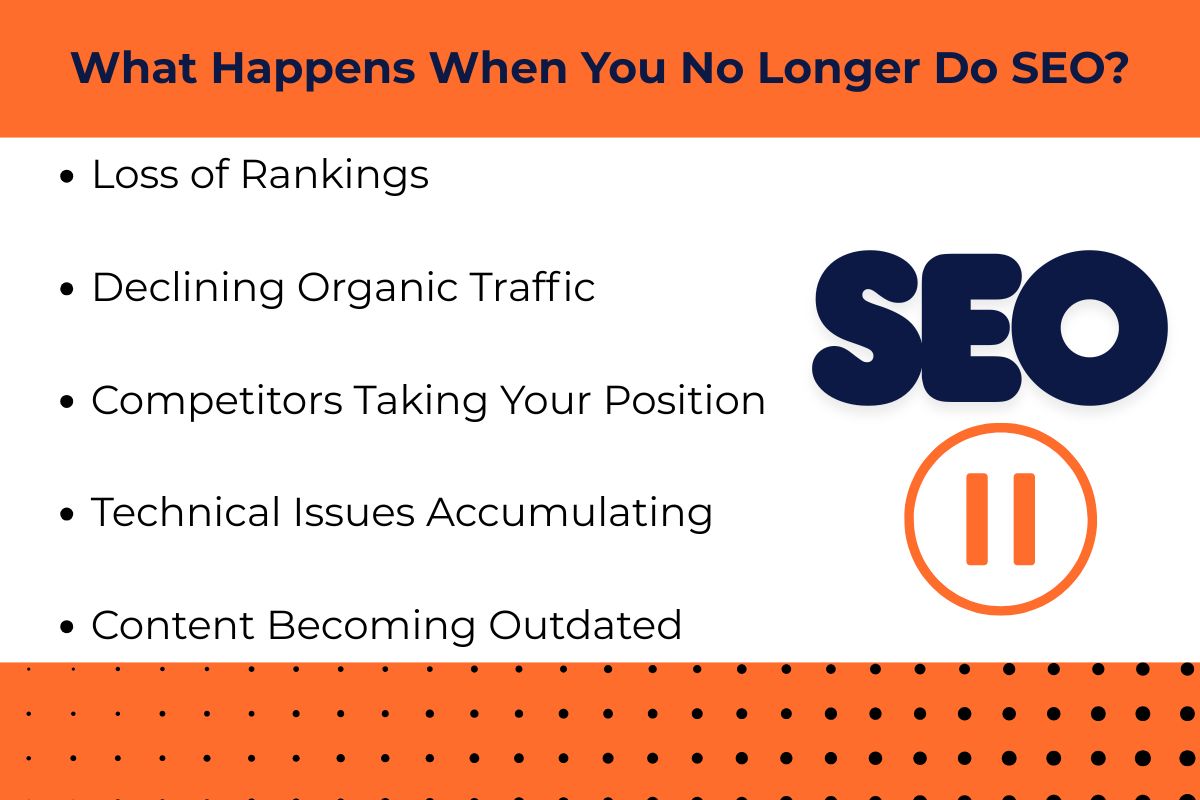
Loss of Rankings
Your search rankings are not static. They can change any day, even without you making a single update.
Your competitors could refresh their content, pick up new backlinks, or redesign their pages. You don’t have to do anything wrong, and your rankings will shift anyway.
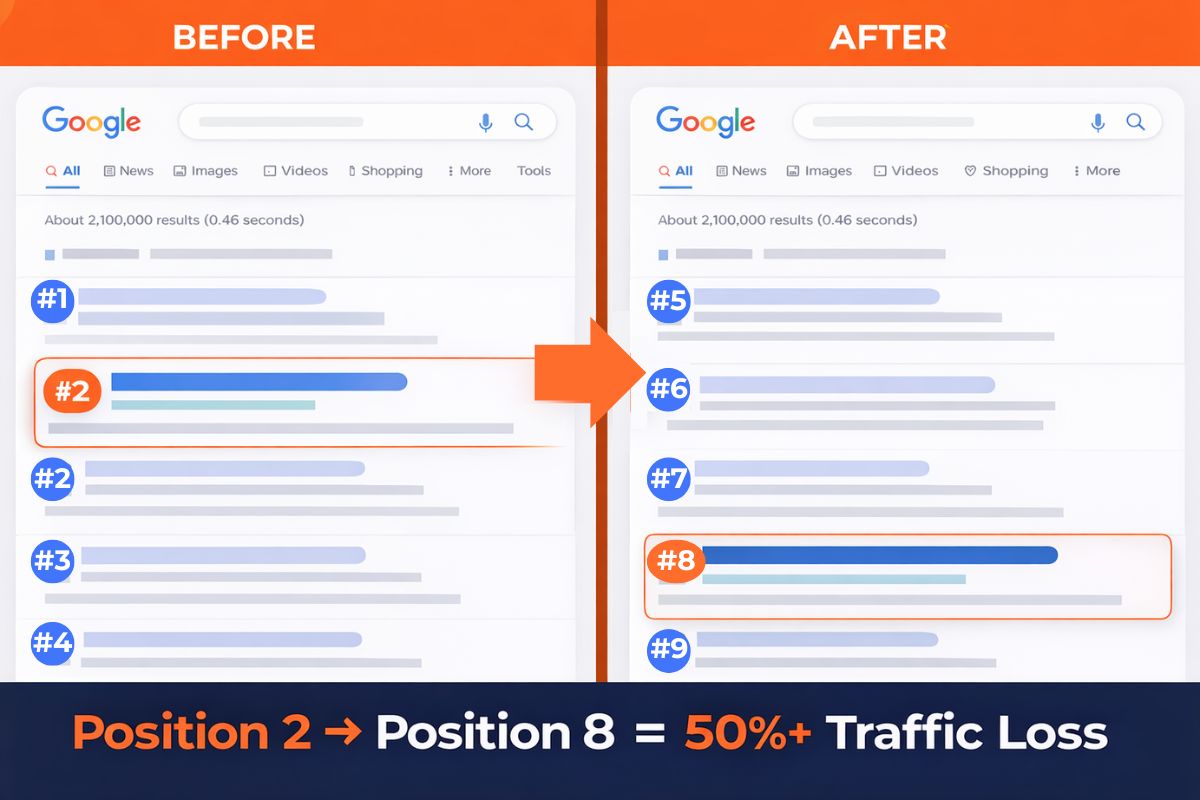
A service page that held a top-three position for years can fall to seventh or eighth simply from neglect. That kind of drop can mean losing more than fifty percent of your clicks. The longer SEO neglect goes on, the worse the damage becomes. Eventually, it reaches a point where recovery is a serious undertaking.
You Stop Gaining Traffic
Gradual traffic loss usually goes unnoticed at first. You’ll see a slow, steady decline on your analytics dashboard, easy to explain away in the short term, but impossible to ignore after six months.
Common causes include outdated content, lost backlinks that go unreplaced, unresolved technical issues, and pages that no longer match current search intent. These all contribute to an organic traffic drop, and by the time it’s obvious, restoring that traffic takes far more effort than maintaining it would have.
Competitors Overtake You
Every ranking position belongs to someone. When you lose one, a competitor gains it.
This is especially true if your competitor is actively investing in SEO by building new backlinks, developing topical authority, and improving user experience. These all signal momentum to search engines. Google rewards that momentum and adjusts rankings accordingly. A stagnant site, on the other hand, signals declining value.
This is one of the most significant reasons why stopping SEO is a bad idea, because your competitors don’t stop just because you do.
Technical Problems Compound
SEO maintenance isn’t just about content. The technical SEO matters just as much.
Websites naturally develop issues over time, such as broken internal links, slow load speeds, outdated plugins, and crawl errors. Without regular SEO audits, these problems accumulate quietly and start affecting performance before you even realize it. The importance of ongoing SEO maintenance for businesses is nowhere more evident than here. Skipping proactive maintenance is a ticking time bomb.
Outdated Content
Google aims to surface content that is meaningful and relevant to people right now. A three-year-old blog post with outdated statistics won’t hold its position, especially when competitors have published more comprehensive and up-to-date guides.
Refreshing existing content is not only faster but often more effective than creating something new from scratch. When SEO stops, that refresh cycle stops with it.
The Value of Ongoing SEO for Businesses
Consistency is what search engines reward. And it goes beyond just the website you’ve already built.
SEO Is a Long-Term Play
The most common reason businesses stop SEO is impatience. Results take time, and it’s hard to commit to a strategy that doesn’t show clear returns within a single quarter.
But authority accumulates gradually, through content depth, link growth, and the kind of technical trust that develops over months and years. Stopping partway through breaks that compounding process. It’s like stopping contributions to a retirement account because you can’t see the balance growing fast enough.
SEO Builds Brand Strength
Consistent visibility builds familiarity, and familiarity builds trust. When your brand consistently appears for relevant searches, authority is gained in a way that paid ads simply can’t replicate.
When visibility and rankings are lost, competitors fill that gap. Measurable results from SEO strengthening your brand deliver real equity, not just a marketing concept.
SEO Protects Revenue Channels
SEO is one of the consistently highest-ROI marketing channels available to businesses. Paid advertising only drives traffic as long as the budget holds. SEO continues producing returns as long as the effort continues.
Tracking SEO ROI reinforces the direct connection between traffic and revenue. Businesses that rely heavily on organic leads feel the impact of traffic fluctuations quickly and clearly.
Data-Driven Decisions
With the right tools in place, your SEO provider is continuously analyzing traffic, on-page SEO metrics like impressions and click-through rates, keyword position shifts, and conversions.
When a business stops SEO, most of that tracking stops too. Gone with it is the visibility into how customers are searching, how their behavior is shifting, and where competitive gaps are opening up before anyone else notices.
The Hidden Cost of Pausing SEO
Stopping SEO is unique in that the consequences aren’t immediate.
For three to six months, traffic and conversions may not be significantly affected, and businesses can convince themselves that pausing SEO was a defensible decision. But during that time, rankings are quietly slipping, competitors are reinforcing their positions, backlinks are going unbuilt, and Google is gradually adjusting how much authority it assigns to your site.
The importance of ongoing SEO maintenance for businesses comes down to this: ongoing maintenance is preventative. Once the numbers show the damage, recovery will always cost more than prevention would have.
Common Misconceptions About Stopping SEO
“We Rank #1, So We’re Fine”
Ranking number one is not a permanent state. It belongs to whoever is currently doing the most to earn it. Competitors will take that position if you’re not consistently maintaining and updating your site.
“We’ll Restart SEO Later”
It’s not as simple as flipping a switch. Taking a break from SEO can lead to lost authority with Google. The longer the pause, the harder it becomes to reclaim what would have been easy to maintain.
“Paid Ads Can Replace SEO”
The moment you stop paying for ads, that traffic stops. You’re not building anything lasting. Paid ads and SEO can work well together, but replacing SEO with ad spend means giving up on long-term organic traffic entirely.
Watch Your Branded Search Volume
Here’s something most businesses miss.
When SEO efforts are paused, branded search volume often starts to decline several months later. Not because anything changed on the business side, but because organic visibility drives brand discovery. If fewer people are finding your content, fewer people are searching your brand name.
Monitoring branded queries in Google Search Console can reveal early warning signs before overall traffic takes a hit. Most people don’t realize how far the effects spread until it’s too late.
Case Study
A local service company ranked for 20 high-value keywords. They paused SEO with no content updates, no link building, and no technical audits.
Six months later:
- 8 of those keywords had dropped off the first page
- Organic traffic fell by 35%
- Competitors had captured the featured snippets that this company used to own
Getting back to where they were required a full technical overhaul and heavy link-building investment. It cost significantly more than simply keeping up with SEO would have. And this is not some rare edge case. It happens all the time, across every industry and every business size.
The Advantages of Staying Consistent
The benefits of ongoing SEO maintenance services aren’t just protective. With consistency comes compounding traffic growth, stronger topical authority, faster adaptation to algorithm changes, and more predictable leads each month.
This is why Indexed Zone SEO and other experienced agencies emphasize continuous optimization over one-off projects. Systems that keep improving over time generate far more value than anything done once and left alone.
Take Action Before Rankings Slip
If SEO is generating leads or revenue for your business, neglecting it is a risk most businesses can’t afford to take.
Evaluate where you stand. Are your traffic and keyword positions moving in the right direction? Are technical issues building up unaddressed? Recognize that the damage from neglecting SEO maintenance will catch up eventually. Ranking positions are far easier to maintain than they are to reclaim.
Search visibility improves with time and consistent effort. The same is true of neglect.
FAQ
Usually three to six months, though in highly competitive industries, the timeframe can be much shorter.
Yes, but recovery typically takes longer than maintaining consistent progress would have. Lost authority and backlinks have to be rebuilt from scratch.
Especially small businesses. With less brand equity to fall back on, they’re more sensitive to ranking fluctuations than larger, more established competitors.
It’s a compounding problem. Gradual traffic loss goes unnoticed for months — until it starts affecting the bottom line, at which point fixing it costs far more than prevention would have.