Simply being on the web is not enough for businesses to stand out. Brands are competing for visibility on search engines, social media, emails, and paid ads, and customers want search results and feel they are entitled to a better overall experience. Without a clear purpose to these efforts, even the most innovative campaigns can and will fail. This is why SEO goals are so important. When tied to a marketing campaign, the optimization directly affects visibility, and it can lead to substantial and increasing growth for your business.
What Are SEO Goals and Why Do They Matter?
The SEO goals are the results that you can measure to determine the effectiveness of your optimization efforts. Goals such as ‘getting more traffic’ are vague and unhelpful. How do you want users to behave on your site, and what do you want them to do before they leave? If you do not define these factors, you risk the possibility of optimizing for metrics that will not help your business, even if they look good on paper.
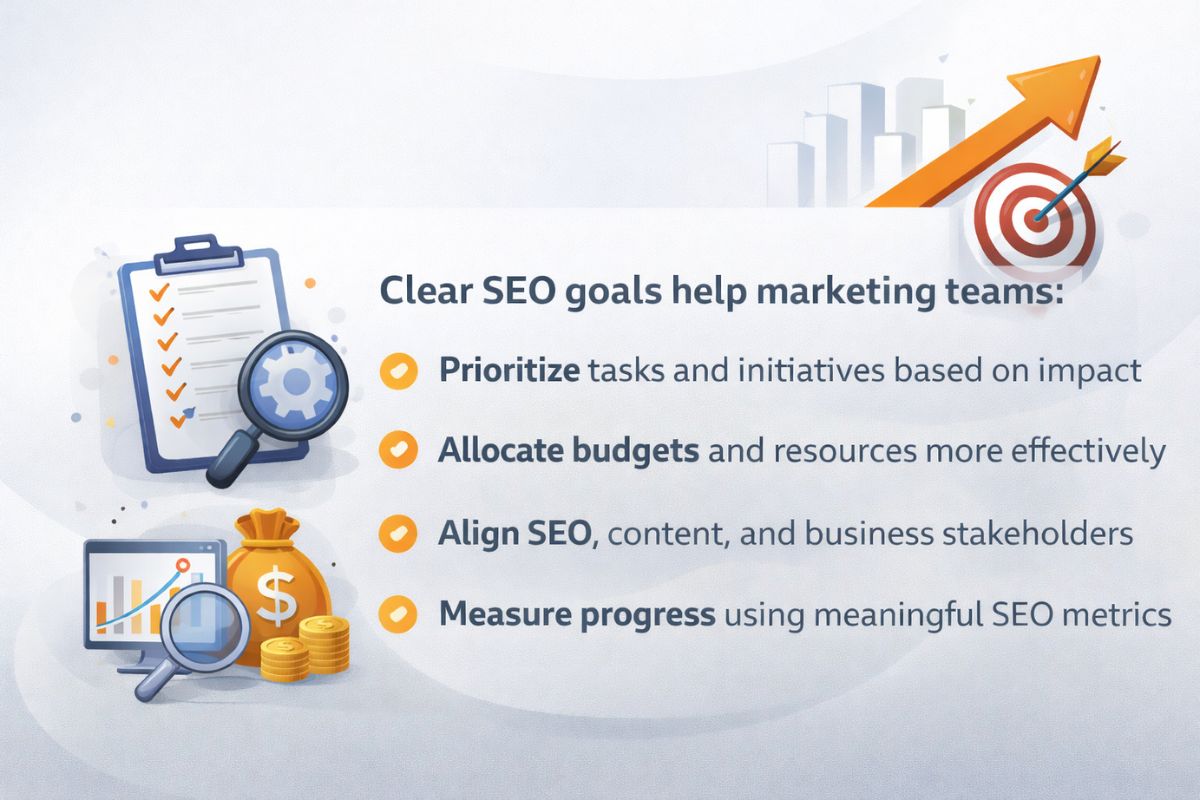
Having clear guidelines allows marketing teams to establish a reliable foundation to build off:
- They can order their tasks based on what is most important to the company
- Justifying budget and resource allocation decisions becomes easier
- Stakeholders in SEO, content, and business can align with common goals
- Using SEO metrics that correlate to the success of the business, progress can be tracked
SEO lacks focus and structure, which is why teams tend to pursue rank targets without a goal and create content without reason. SEO is in far better shape with clear goals; without them, the channel becomes an experiment with high volatility and low predictability.
Top-Level SEO Goals Within a Marketing Strategy
When it comes to the marketing strategy of successful marketers, there is a handful of widely accepted SEO goals that tend to stick. Knowing these allows you to effectively embed optimization into your holistic campaigns.
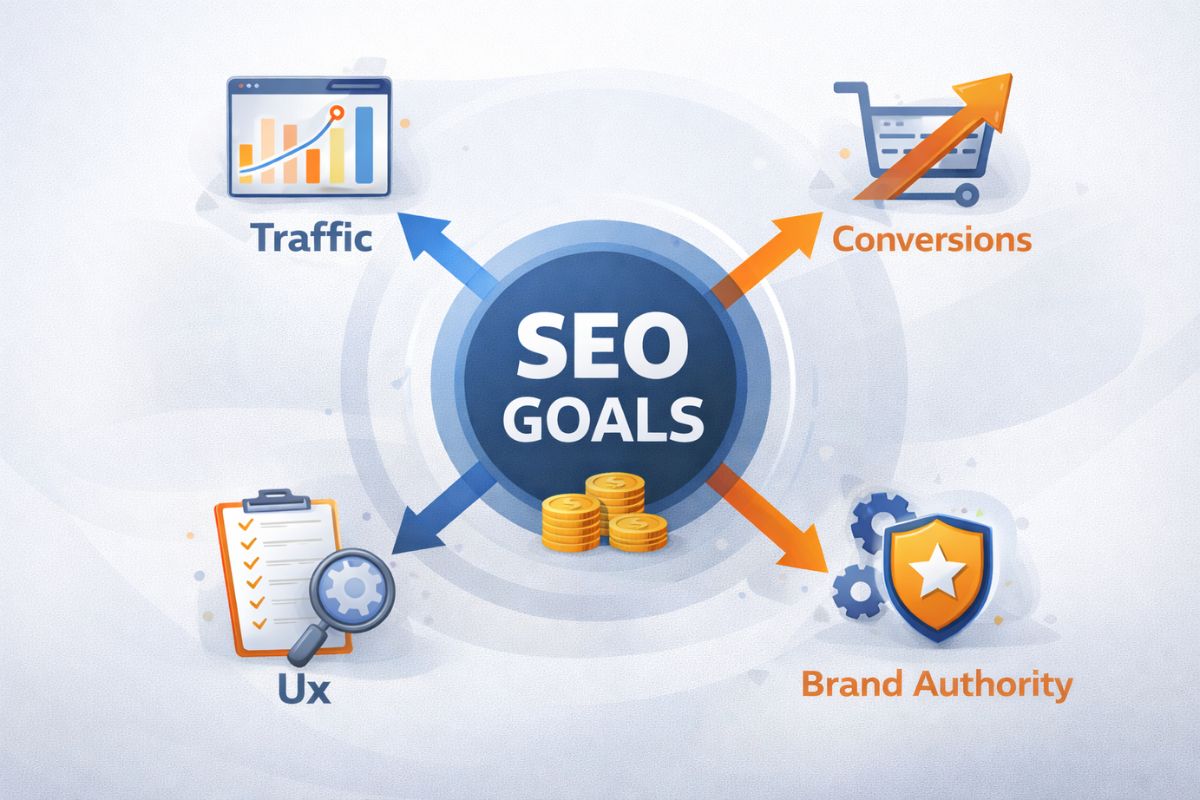
Core objectives generally involve:
- Developing organic search visibility for your target audience
- Obtaining qualified traffic with genuine purchase/conversion intention
- Enhancing the overall user experience on the website
- Developing industry expertise and credibility
Generally, these objectives help to enhance search engine rankings and genuine utility to the audience.
SEO Marketing Goals vs. General Marketing Goals
Although SEO marketing goals and general marketing goals are dependent on each other, they are based on different timelines. Conventional marketing focuses on short-term wins: a burst in activity, a seasonal promotion, a new product. SEO is different. Its value is long-term, which also makes it a lot more difficult to justify.
Where SEO marketing objectives differ:
- They emphasize prolonged keyword prominence above fleeting clicks
- Achievement consists of organic conversions, not paid attribution
- Content performance, engagement metrics, and ranks are all equally important
- Established brand authority and trust are treated as assets
While SEO is something that takes time, other marketing channels tend to demand patience a little less. However, time and investment in SEO pay off more than other channels. With paid marketing, as soon as you stop spending, your traffic dries up. With SEO, it’ll still be there.
Developing SEO Objectives That Support Business Objectives
Developing your business’s objectives comes before all other steps and is perhaps the most critical, yet most overlooked. Once you have a clear focus, the objectives can shift to it with confidence. SEO objectives can then be woven closely with revenue goals, lead generation, or brand awareness objectives. And if your business has no direct line between the outcome of the business and the SEO work, the goal you have most likely is not specific enough.
When determining how to establish SEO goals for a business, a practical approach involves several steps:
- Work backward by focusing on the primary goals for the company
- Identify your target audience and their potential digital footprint
- Divide SEO goals according to the different stages within a funnel
- Considering market competition and available resources, be realistic in your timelines
SEO goal-setting is S.M.A.R.T. (Specific, Measurable, Achievable, Relevant, and Time-bound). Achieving this correlates SEO initiatives with business goals and objectives so they do not exist on a separate, vague island.
Examples of Effective SEO Goals
What goals of SEO initiatives should look like is specific and quantifiable. A vague target like “traffic should be more” or “we should rank higher” gives workers no real destination. Effective goals, depending on a specific business model, could emphasize volume, conversion, engagement, or brand search.
Examples of targets that can be achieved:
- Target a 25% increase in organic sessions to key product or service landing pages within 6 months
- Set a target to improve the conversion rate from organic traffic by 10% in the next quarter
- Target a reduced bounce rate on high-traffic blog posts and increased average time on page
- Set a target to increase branded search volume to increase brand recognition and trust over time
In addition to each of these targets, a period of review and an explicit KPI are crucial to keep the team accountable to tangible results.
SEO Goal Performance Measurement and Tracking
A list of tasks without measurement is guesswork. Measurement, especially over time, provides invaluable insight into the next opportunity and whether your strategy has merit.
A large number of teams analyze click-through rate and conversions from organic traffic, organic traffic trends, and keyword performance. This can be made much more informative by examining the underlying page and backlink quality metrics. The more technical indicators, including crawlability and Core Web Vitals, should be looked at frequently.
Your insights from regular reporting should be used to improve decision-making from a reactive state and to strengthen the connection between your marketing priorities and your SEO goals.
The Importance of Knowledge and Planning for an SEO Strategy
What planning is there for SEO objectives without a strategy? Still just a list. Optimized planning for SEO is a result of built-out decisions on what keywords to target, what technical issues to address, where to invest in content, and long-lasting ways to build authority.
Most serious brands about SEO seek out experts like Indexed Zone SEO to establish achievable goals, spot true ranking prospects, and keep adjusting to algorithm changes without falling behind.
An effective SEO strategy includes the technical fundamentals and site speed, the relevance and depth of content, the activities to establish authority, and the ranking factors that actually determine your position in search engines. Setting your objectives based on these factors is what separates a plan that works from one that merely sounds appealing.
Common Mistakes Brands Make When Defining SEO Goals
The most common mistake is setting goals that are too vague to measure. “Rank number one for [keyword]” sounds like a goal, but unless that ranking is connected to revenue, leads, or meaningful engagement, you won’t actually know if it’s worth pursuing. Another common trap is becoming fixated on rankings while ignoring what happens after someone clicks.
Other mistakes that consistently hold teams back:
- Setting timelines that don’t reflect how long SEO actually takes to show results
- Ignoring search intent and optimizing for keywords that the audience isn’t really using
- Failing to revisit and adjust goals as markets, competitors, and algorithms shift
Avoiding these mistakes isn’t complicated, but it does require the discipline to review performance data honestly and adjust course without ego getting in the way.

How SEO Goals Strengthen Your Overall Marketing Strategy
When your SEO goals are clearly defined, they make everything else work better. Content gets sharper because it’s written for a specific search intent. Paid campaigns benefit from landing pages that have already been optimized for organic performance. Brand messaging stays consistent because the SEO research reflects exactly what your audience is looking for.
SEO insights also feed into broader business decisions: product development, customer support priorities, content gaps, and messaging frameworks. That’s what makes SEO a strategic input rather than just a traffic source. When it’s treated that way, its influence extends well beyond the search results page.
Make SEO Goals a Core Part of Your Strategy
Without clear goals, SEO becomes a background activity that teams can’t measure, manage, or justify. When objectives are specific and tied to business outcomes, everything changes. You can make confident decisions about growth priorities, allocate budget with purpose, demonstrate ROI to stakeholders, and keep your team pointed in the same direction.
Effective SEO doesn’t require the biggest budget. It requires clarity. The brands that consistently win in search are the ones that know exactly what they’re working toward and why. If SEO is being treated as a passive background project that will somehow generate traffic on its own, the results will reflect that. Set clear objectives, build a real strategy around them, give it the time it needs to work, and the results will follow.