The sudden decline of a website’s organic traffic can be distressing. Things seem to be fine one moment, with continued engagement and a constant flow of leads. For an unknown reason, traffic is now completely silent. The initial response is to panic and begin making changes to the website. Most of the time, these website changes create more problems than they solve.
The decline of a website’s organic traffic is rarely a random event. Most times, there is a reason, and it could be a number of reasons. The reasons could be behind the website’s technical issues, changes in the algorithm that determines the website’s search engine ranking, changes in the competitiveness of the website’s surrounding market, or an unimplemented strategic reason. Most of the time, website owners’ recovery attempts are simply blind guesswork.
The purpose of thisarticle is to inform website owners of the possible reasons behind the sudden decline of organic traffic to a website, and the steps needed to be taken in order to fully rectify the website’s issues.
How to Diagnose a Sudden Drop in Organic Traffic
The first step in making a recovery attempt is to confirm the website owner’s suspicions. Most website owners assume there has been a drop in the website’s ranking by search engines when it could be a tracking mistake, the time of the year, or a change in the way Google presents its search engine results.
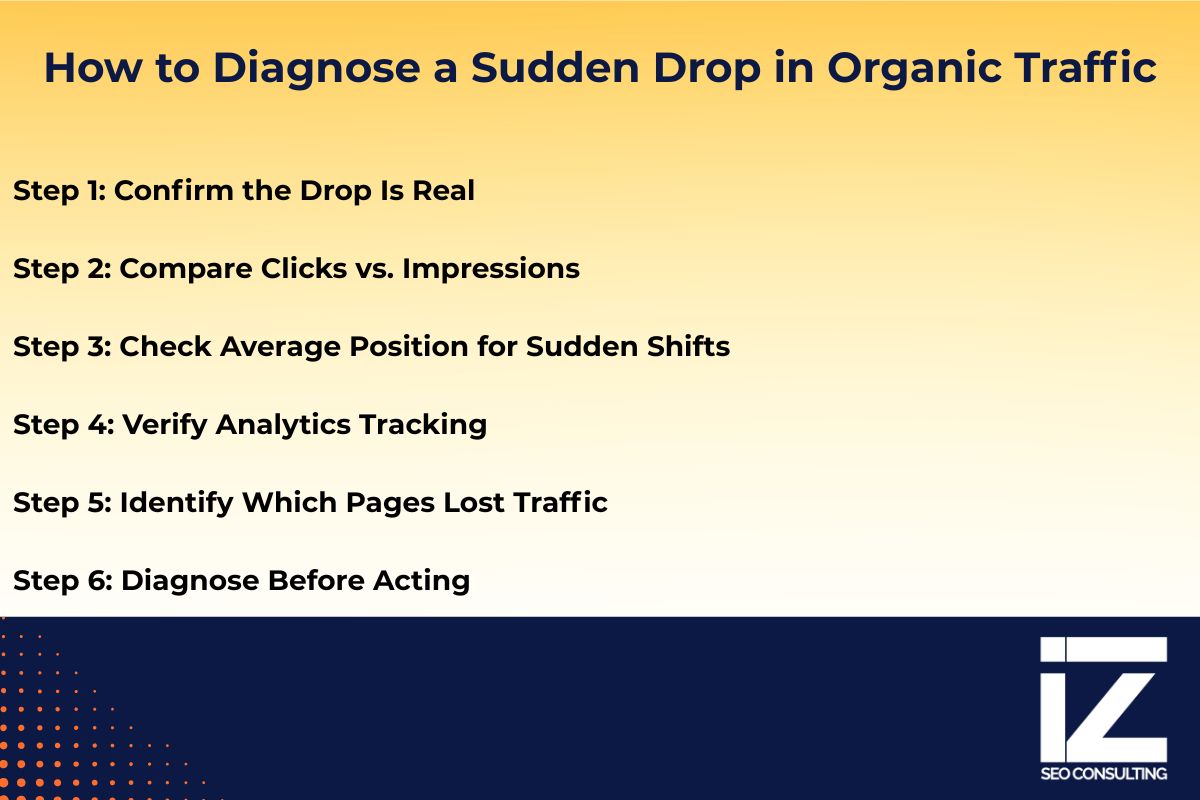
Begin with Google Search Console. Select the last 28 days and compare them with the period before it, and focus on three things:
- For the last 28 days, compare the number of clicks and the number of impressions. If impressions have dropped significantly, then the issue is visibility.
- If the number of impressions is constant and the number of clicks shown is lower, then the issue is often associated with the click-through rate and not the rankings.
- For the average position, a specific date linked with a sudden SEO drop usually corresponds with an algorithmic update.
Now move on to analyzing your analytics tracking. GA4 misconfiguration, tags not firing in Tag Manager, and a tracking code not present will cause a fake drop in traffic. A quick look at the real-time traffic will take a few minutes to confirm this.
Next, determine which specific pages lost traffic:
- Technical or algorithmic causes often cause sitewide losses.
- Single category or cluster losses usually suggest content or competition issues.
- One or two pages lowering traffic may be a result of problems with cannibalization or mismatched intent.
Action comes after diagnosis. Always.
Top 10 Reasons Websites Have a Drop in Organic Traffic
With real audits and recovery work, there is almost always a pattern to every case. Here are the top 10 reasons there are drops in organic traffic to websites.
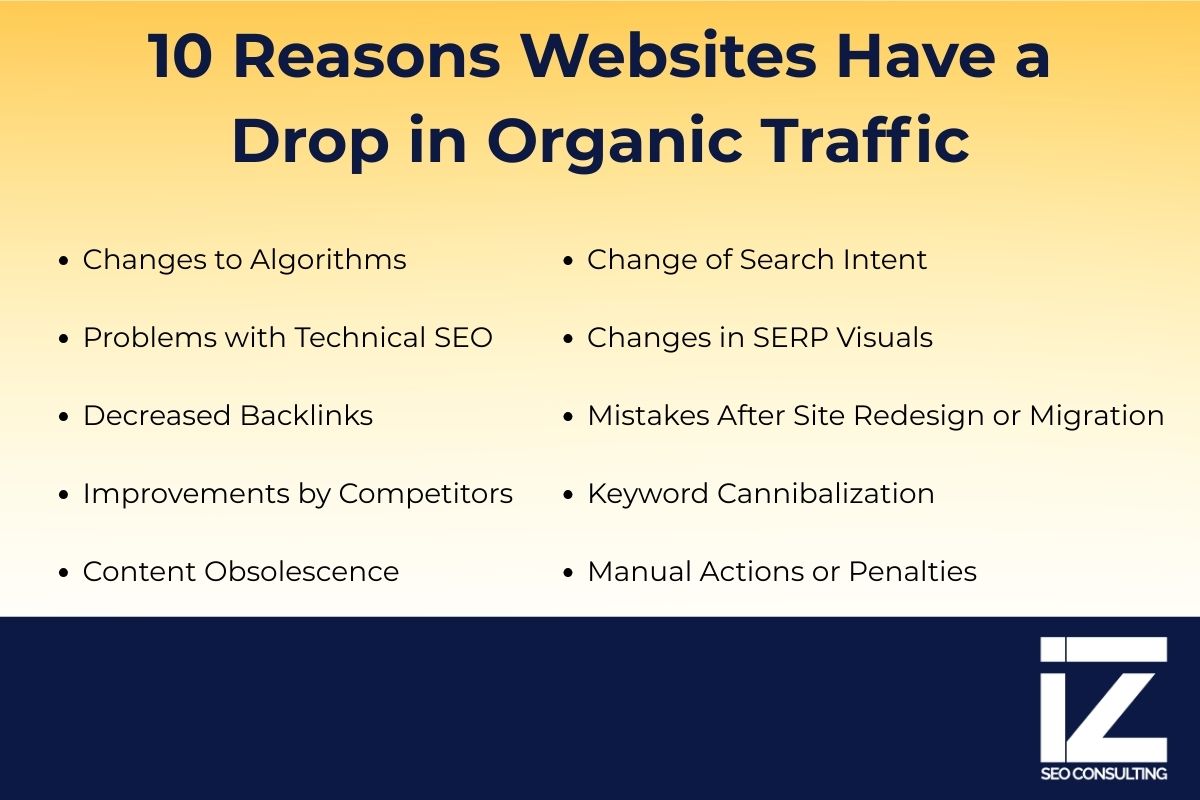
1. Changes to Algorithms
A decrease in organic traffic can often be attributed to one of Google’s core updates. Traffic can drop even when absolutely nothing has changed on a website, as Google could alter its assessment of content quality, authority signals, and intent alignment. When quality updates hit informational pages, those pages are often the most affected.
2. Problems with Technical SEO
A decrease in SEO can often be the result of technical issues. Here are a few examples:
- Accidental indexing tags
- Mistakenly blocked pages in robots.txt
- Mistakenly set canonical tags
- Remaining virtually invisible after a site redesign or blockage
Many businesses fail to appreciate the damage a small error in indexing can do, which is why, after spending months pondering their problems, many sites remain without catching issues that a basic understanding of technical SEO would enable.
3. Decreased Backlinks
Loss of even a small number of high-authority links, especially in competitive areas, can result in a visible drop in SEO rankings. If a referring domain updated its content, went offline, or removed your link, your rankings could drop.
4. Improvements by Competitors
In some cases, losses in organic traffic can be attributed to competitors rather than ourselves and our marketing activities. Our competitors may have:
- Published content that is stronger and more comprehensive than our content
- Acquired new backlinks from sites of greater authority than their competitors
- Better optimise their pages to match current search intent
When competitors improve more than us, SEO rankings will drop even if our own site remains unchanged. This is one of the most silent forms of position loss.
5. Content Obsolescence
Two to three years ago, many articles performed and functioned well, but gradually over time, these articles without constant updates will lose their edge. This loss of edge could be due to the age of the articles and the publishing of new competition and content that is more relevant. This tends to be one of the more silent causes and forms of traffic loss. This form of traffic loss will inevitably build and result in losses that become highly noticeable.
6. Change of Search Intent
It is highly pronounced that search intent will evolve over time. This can be evidenced in the case of keywords that used to be focused more on long-form blog content than would have once favoured short-form content such as product pages, videos, or listicles. If the content and the format used to produce the content no longer align with the expectations of searchers, any drop in organic traffic would be sudden and without any technical changes.
7. Changes in SERP Visuals
Google continuously adds new functionalities, including AI summaries, featured snippets, video carousels, and additional advertisements. These elements drive down organic search results, resulting in fewer clicks, even if your position in search results remains unchanged. This is the reason behind the decrease in Google’s organic search traffic, while your position in search results remains unchanged.
8. Mistakes After Site Redesign or Migration
Redesigning a website is one of the most common reasons for a drop in website SEO rankings. Common errors are:
- Improper or no redirects
- Internal URL structure changes without allowing for new URL mapping
- Missing or broken internal links
- Pages were deleted without any strategy
9. Keyword Cannibalization
When multiple pages compete for the same keywords, it’s common for Google to rotate rankings among competitors instead of selecting one “winner.” This results in suppressed rankings for all competing pages. To minimize common SEO mistakes, a routine content audit is essential.
10. Manual Actions or Penalties
While errors resulting in thin affiliate content, spammy linkage, or cloaking are less common, they can result in a significant drop in SEO performance. Before assuming issues are due to changes in Google’s algorithm, be sure to check Google Search Console for any flagged manual actions.
Reasons for an Organic Traffic Decline Despite Ongoing SEO Work
The steady decline in website traffic can be understandably perplexing, particularly when there are active SEO efforts underway on the same website. There are several reasons an organic traffic decline can occur despite continued SEO efforts:
- The website may be over-optimized for specific keywords, resulting in a drop in ranking due to algorithmic suppression.
- The website may be using outdated link-building strategies. Links, especially those that are low quality, are often perceived as detrimental to a website’s authority over time, even if they are initially viewed as harmless.
- Poor tracking methods resulting in a lack of proper measurement cause an SEO data void. Consequently, the SEO metric blindness results in the visibility problems being mistakenly perceived as conversion issues as opposed to the traffic decline.
- The website may have a misalignment for SEO ranking purposes due to a lack of perceived technical problems.
Typically, these issues boil down to problems with the overall strategy of this SEO initiative as opposed to the technical details.
How to Recover SEO Rankings After a Sudden Drop
Once clear problems are causing the ranking drop, the steps to take to achieve positive results become structured rather than reactive.
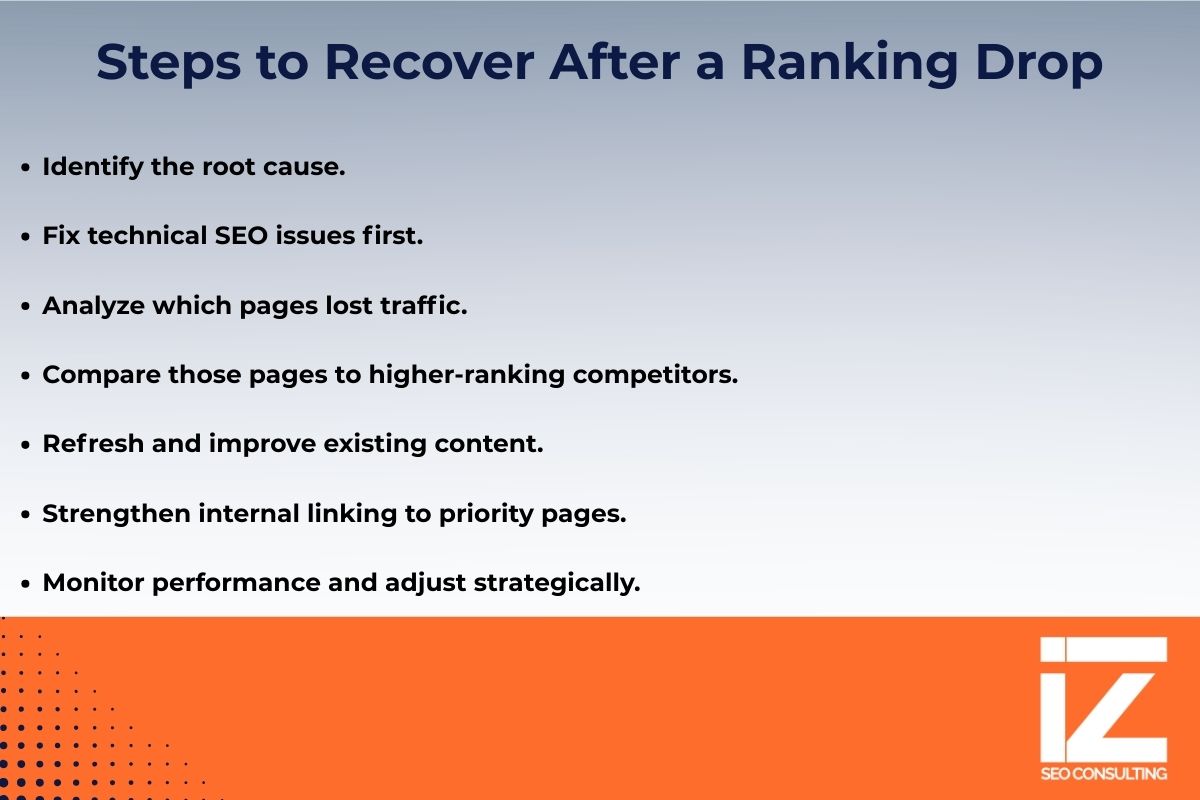
The website must have proper technical SEO implemented in order for the content strategy be successful. If the website’s pages have technical issues, such as being blocked from Google, these must be corrected first. These issues include indexing problems, crawl blocks, and canonical problems. These problems must be corrected before work on the content can begin.
Examine the drops in web traffic on specific pages, and compare the content on the individual pages with the content on web pages that are currently ranking higher. Analyze the individual pages on the following criteria:
- The extent and the arrangement of the content
- The patterns of internal linking
- The alignment with the search intent of users
- The use of relevant media or data
Before replacing content, it is advisable to refresh it. A common reason that is associated with the declining number of visits to the pages of a website is that the pages may need to be updated, and simply creating new pages will likely not be a step in the right direction. Updating the content to include new, more relevant statistics, improving the organization of the content, or eliminating redundant content can improve the quality of the internal links. This process can be completed in a shorter time than starting from the point of zero.
Restore the internal linking authority. In many cases, the drop in the ranking of web pages is attributable to a reduction in the internal linking authority following a redesign or some form of content culling. In a shorter time than one would expect, reinforcing internal links to the prioritized web pages can enhance the page rank.
In many cases, the drop in the ranking of web pages can be avoided simply by following a proven process. In such cases, the process provides the website with more sustainable data.
Pro Tip: Check Impressions Before Changing Everything
This is a point that is often overlooked. When impressions are consistent, but there is a drop in the number of clicks, rankings are not likely to be the core of the problem. The drop could be related to a decrease in the click-through rate. This means that the title and the meta description may no longer accurately represent what users are searching for. SERP features may be lowering your website ranking.
This means rebuilding pages is not the solution. When the titles and headers are modified to align with user expectations, traffic is often restored faster. At this level, optimizing for search engine relevance is what differentiates reactive SEO from strategic SEO.
It is a minor difference, yet it transforms the entire recovery strategy.
Take the Right Next Step
A sudden drop in organic traffic is rarely random. There is usually a clear reason for the drop, and the answer is usually the same: a clear focus. The sites that respond the fastest typically develop a plan instead of panicking.
Don’t be in a hurry. Review the analytics and determine the cause of the drop and the potential solutions. If the problem is bigger than expected, consulting with industry experts such as Indexed Zone SEO can help discover some of the underlying structural issues.
An SEO drop is not the end of the world. It means something has changed. It is not a lack of effort that needs to be found.
FAQ
Organic traffic drops for several reasons, including algorithm changes, and more recently, changes to the website, the loss of backlinks, or changes in competitor traffic. Each of these issues can be the cause of a sudden and unexplained drop. It is important to first identify the reason before taking action.
It is possible to recover dropped rankings. Most of the time, drops are caused by fixable issues such as intent mismatches, technical problems, or loss of authority. The first step is always finding the correct cause of the problem.
Technically, the fixes for the issues can show improvements in a few weeks. When issues are caused by algorithms, the time varies depending on the issues at hand, which may not be resolved until the next core update.
We can achieve the fastest recovery for SEO rankings by first resolving the technical issues, improving the pages to better align with the intent of the users, and strengthening the internal linking.