Imagine that your website is a building. Content SEO serves to beautify your building’s interior with things like articles, product pages, and videos. On-page SEO organizes the layout and structures the color scheme with things like keywords and headers. Technical SEO, however, shapes the building’s foundational structures, like the electrical system, the plumbing, and the wiring. Without technical optimization, the building collapses.
With trends like Generative Engine Optimization (GEO) and Answer Engine Optimization (AEO) changing the way users look for information, technical SEO becomes even more important. In this guide, we will cover everything there is to know in order to keep your website fast, visible, and trusted by users and search engines.
What is Technical SEO?
Technically, there is nothing wrong with your website, and that’s the point. It is a certainty that nothing positive will ever happen with your page rank if the technical elements that optimize your website for search engines remain poorly managed. This includes things like website speed, mobile friendliness, site security, and structured data. Technical SEO solves all of these elements.
Poor optimization techniques lead to poor technical SEO, spell cull in the content, and overall poor website performance. Technical SEO is foundational to search engine optimization. It is the first step to search engine dominance, and it all starts with enabling your website to be crawled, indexed, and understood by search engines.
Widen your perspective by discovering the interrelation of technical SEO and content SEO, recognizing the essence of optimizing the full potential of your digital footprint.

Why is Technical SEO Important?
Have you experienced Google overlooking some of your pages? Are users bailing out in seconds? The underlying root cause of your issues may be your technical foundations. Ignoring the importance of technical foundations should not be overlooked in the equation. Technical SEO is the foundation that provides:
- Search engines that crawl and index your site in the best possible way, one that is clean and free of dead ends, duplicate pages, or bad pathways
- Users who enjoy fast, safe, and mobile-optimized browsing keep them on your site and build trust
- Your site is prepared for voice search, AI-written summaries, and zero-click searches
Technical SEO is more than about Google rankings. On-page technical SEO also protects your digital value. Imagine your potential customers or users entering their credit card numbers on a non-HTTPS site that exposes their payment and personal details. That would destroy trust — and sales — instantly.
For big corporations, understanding the importance of technical SEO for enterprise businesses becomes significantly more important. The consequences of technical errors in enterprise sites may consist of thousands of pages going unnoticed or obliterating the entire customer journey.
Primary Elements of Technical SEO
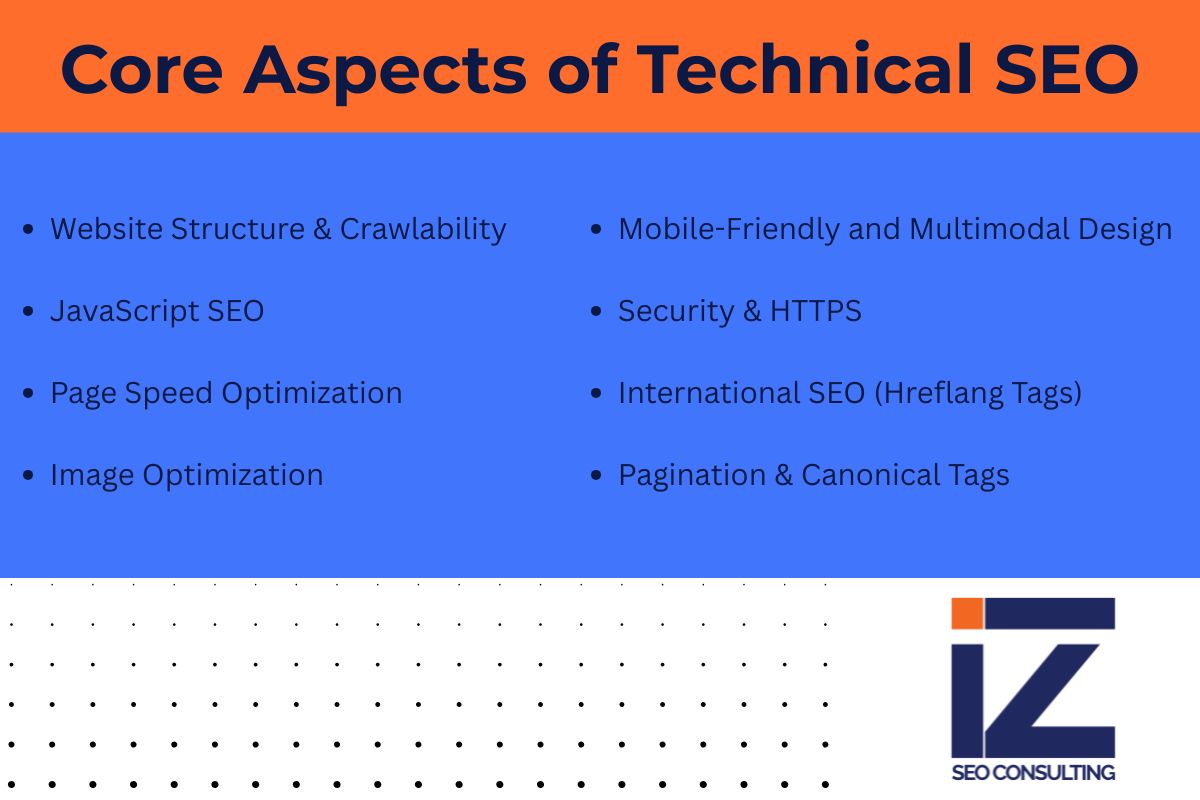
Website structure and how crawlable it is
The architecture of your site determines how Google and your users navigate through it. A well-structured site enables smooth and fast navigation. A strong structure includes:
- Well-defined incremental top-down and bottom-up hierarchical content levels, along with robust interlinking, i.e., guiding search bots and users from broad to specific content.
- Canonical tags: Identifying primary pages assists in preventing duplicate content from detrimentally affecting rankings.
- Structured Data (Schema): “Translators” explain to search engines “this is a recipe” and “this is a product review,” helping to secure rich result opportunities.
Mobile-Friendly & Multimodal Design
Your mobile version serves as the primary version due to Google’s mobile-first indexing. As voice and image search become more prevalent, your technical setup must adapt. Clean responsive design, fast loading times, and suitable alt tags for images help achieve this.
Page Speed & Core Web Vitals
Google looks at LCP (Largest Contentful Paint), FID (First Input Delay), and CLS (Cumulative Layout Shift) as a few of the key metrics to evaluate performance. Your pages need to be interactive and load quickly. You can achieve this by:
- Image compression (use WebP or AVIF format)
- JavaScript & CSS minimization
- Browser caching
- Lazy loading
Users and bots alike become frustrated with slow sites, which negatively impacts your technical SEO and conversions.
Security & HTTPS
Sites not utilizing HTTPS will be penalized in rankings, and browsers may block them. Secure connections are especially important for e-commerce or login-heavy sites.
New Priorities: GEO, AEO, and Machine Trust
Generative & Answer Engine Optimization
With ChatGPT, Gemini, and Perplexity scanning the web, your site should optimize AI search results:
- Capture AI answers with structured FAQs and brief site summaries.
- LLMs are prompted by data standards like the proposed llms.txt
- AEO favors short, direct answers, increasing the chances for your site to be referenced by a conversational AI.
Enhanced E-E-A-T & Brand Trust
Google now evaluates trust with the addition of experience. Case studies, author bios, and real examples convey to the bots and the people the value of your brand.
Brand Trust
Google has continually emphasized authority and trust with the addition of experience. Author bios, case studies, and real-world examples convey to the bots and the people the value of your brand.
Zero-Click and Featured Snippet
Zero-click searches, whereby users do not click and are offered an answer, are expanding. To optimize your chances of being seen:
- Featured snippet targeting: use list, table, and Q&A markup
- Answer “What is technical optimization in web development?” in 60 words and under
- Structure your content so that it can be used in an AI summary
How to Improve Technical SEO Performance
Run Regular Audits
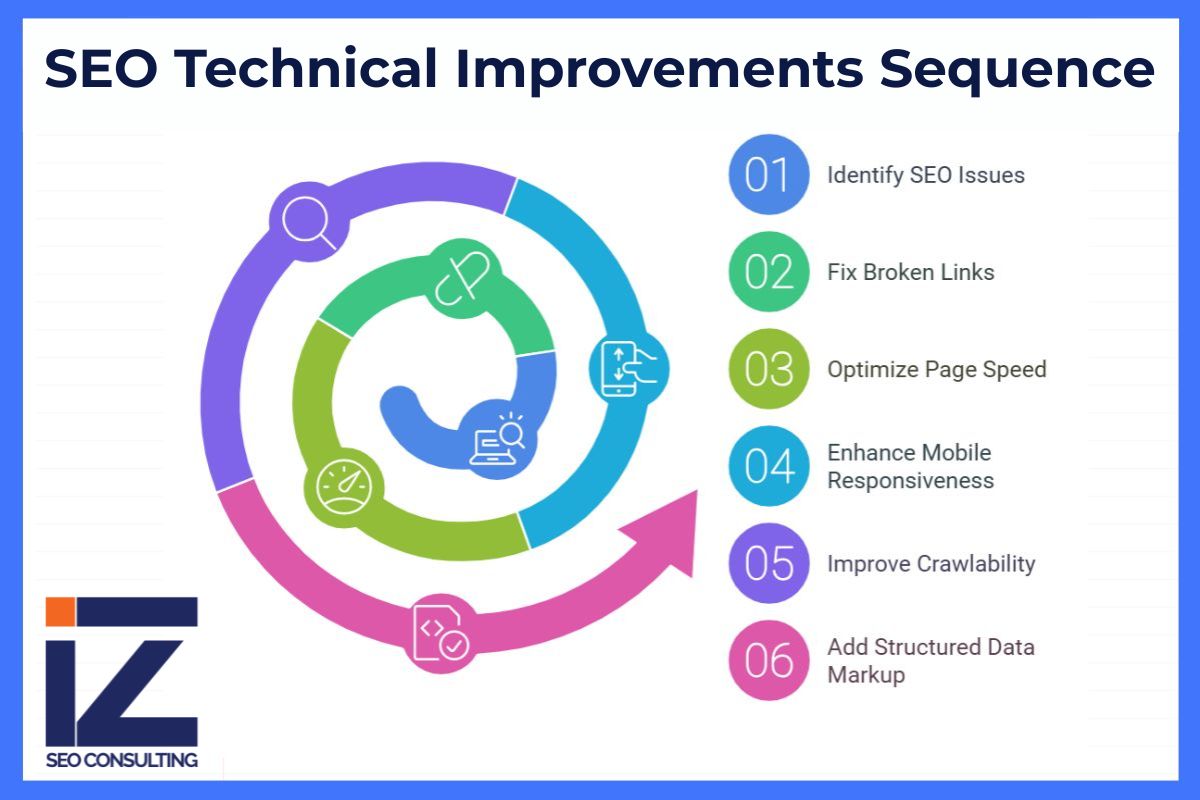
A technical audit is to your site what a health examination is to a person. It uncovers issues before they are costly to fix. Use Google Search Console, Screaming Frog, and Ahrefs to find slow pages, broken links, and crawl errors.
Integrate Adjustments in Technical SEO
Small changes improve things, like using 301 redirects to fix 404s or better optimizing your robots.txt. Enhancing your structured data and making adjustments to your sitemap improves technical seo performance. Bettering Core Web Vitals and simplifying canonical links are also technical seo improvements.
Need help? Indexed Zone SEO consulting can help your business.
Adjust and Monitor
SEO has no deadline. Keep track of changes in the fundamentals of technical SEO, new influencing factors, and updates such as Core Web Vitals and mobile-first optimization.
Future of Technical SEO: What’s Next?
The world is always changing, and so is the digital world. Here’s what’s next:
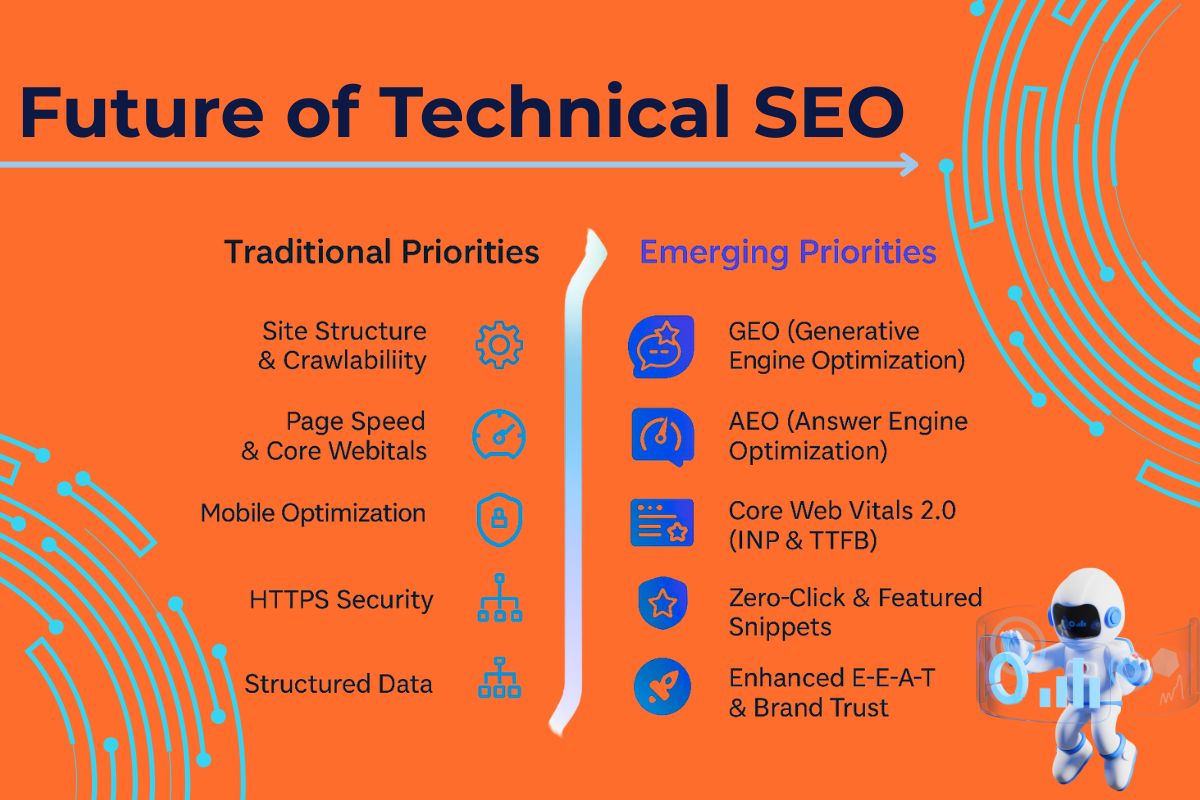
- AI-first indexing: Design your structured data for predictive algorithms and conversational AI.
- GEO & AEO: Add content for AI citation by incorporating a short Q&A
- Advanced Core Web Vitals: Pay attention to FID & TTFB for interactive and speedy sites
- Voice & Visual Search: Prepare for multimodal search by optimizing images with descriptive alt text and text
- Enhanced E-E-A-T: Show the expertise of your team, and include real-world case studies
- Zero-click content: Create content such as lists, tables, and FAQs that are suitable for snippets
Quick Technical SEO Checklist
- Make sure you have a secure (https) connection.
- Make sure your Core Web Vitals, INP, and TTFB page loading times are optimized.
- Use schema markup for your structured data.
- Test for mobile and multimodal compatibility.
- Use clean canonical URLs.
- Make sure you have a Q&A that is snippet optimized.
- Perform regular audits and quickly address issues.
- Use proper XML sitemaps.
- Use proper configurations for your robots.txt file.
FAQs About Technical SEO
Yes, a 10-page site still needs to load quickly and have a clean structure. Technical SEO is not just for big brands.
Switch to HTTPS and compress your images for better loading times.
You should start with an audit request to see what your current status is and what improvements can be made.
Technical SEO is about building infrastructure on your site so search engines can do their jobs and rank your content. Without this, great content won’t get the rankings it deserves.
Ready to Grow Your Business Online?
No one likes doing technical SEO, it’s not pretty, but it keeps your site discoverable, your customers coming back, and helps your site grow over time. Every online business needs to do it if they want to grow and come up with successful strategies.
Whether you are improving load speeds, fixing crawl issues, or readying yourself for the next level of GEO and AEO, investing in technical optimization will pay you back by improving visibility and trust optimization.
Collaborating with a proficient SEO agency can prove invaluable when it comes to tackling any unyielding technical challenges. Indexed Zone SEO brings this level of expertise to help you achieve tangible results for your business.