Ranking above a competitor rarely comes down to luck. Most businesses that consistently beat their rivals in search do one thing the others skip: they study exactly what’s already working in their space and build from there. That’s the core of any solid competitor SEO strategy: not copying what someone else is doing, but understanding why it’s working and finding the gaps they left open.
If you’ve ever wondered why a competitor with a thinner product line or a smaller team keeps outranking you, the answer is usually process, not chance. This guide covers the specific ways to beat competitors in SEO: identifying who you’re actually competing against in the search results, mining their keyword and content gaps, sizing up their backlinks and technical setup, and turning all of that into a plan that moves your own rankings instead of just describing theirs.
Start by Finding Your Real SEO Competitors
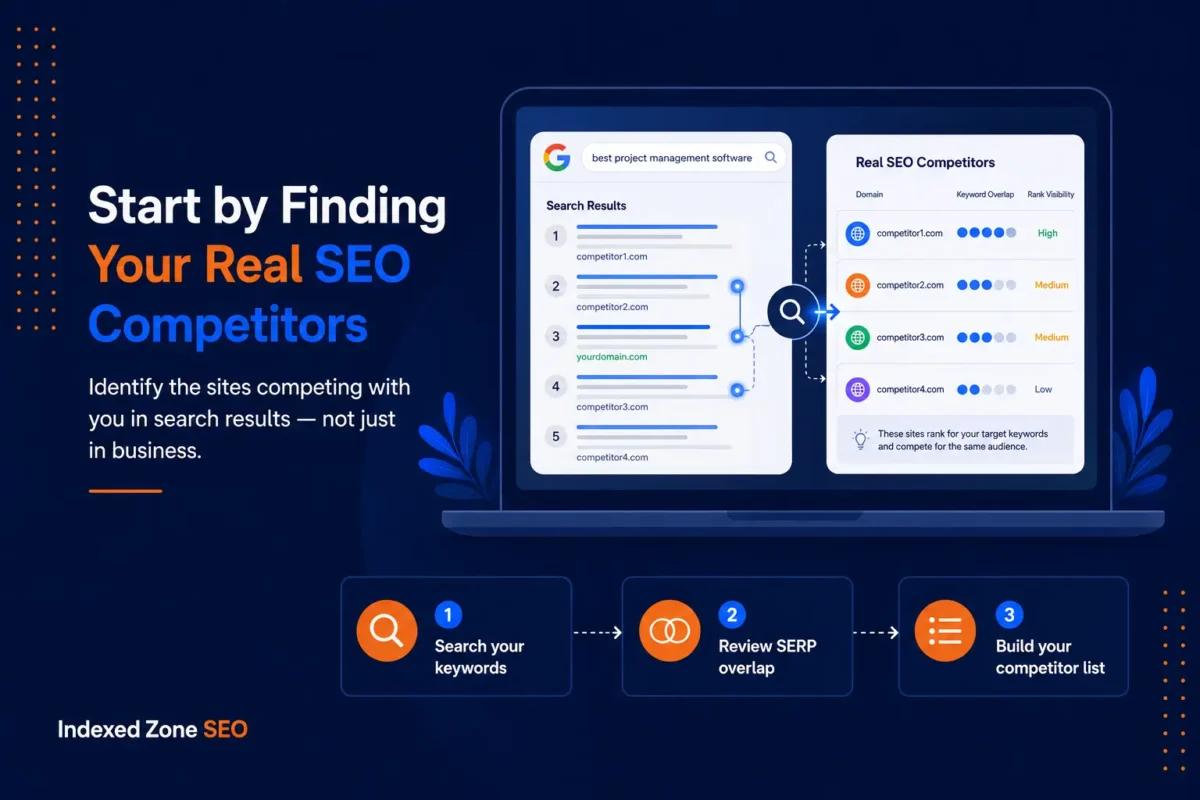
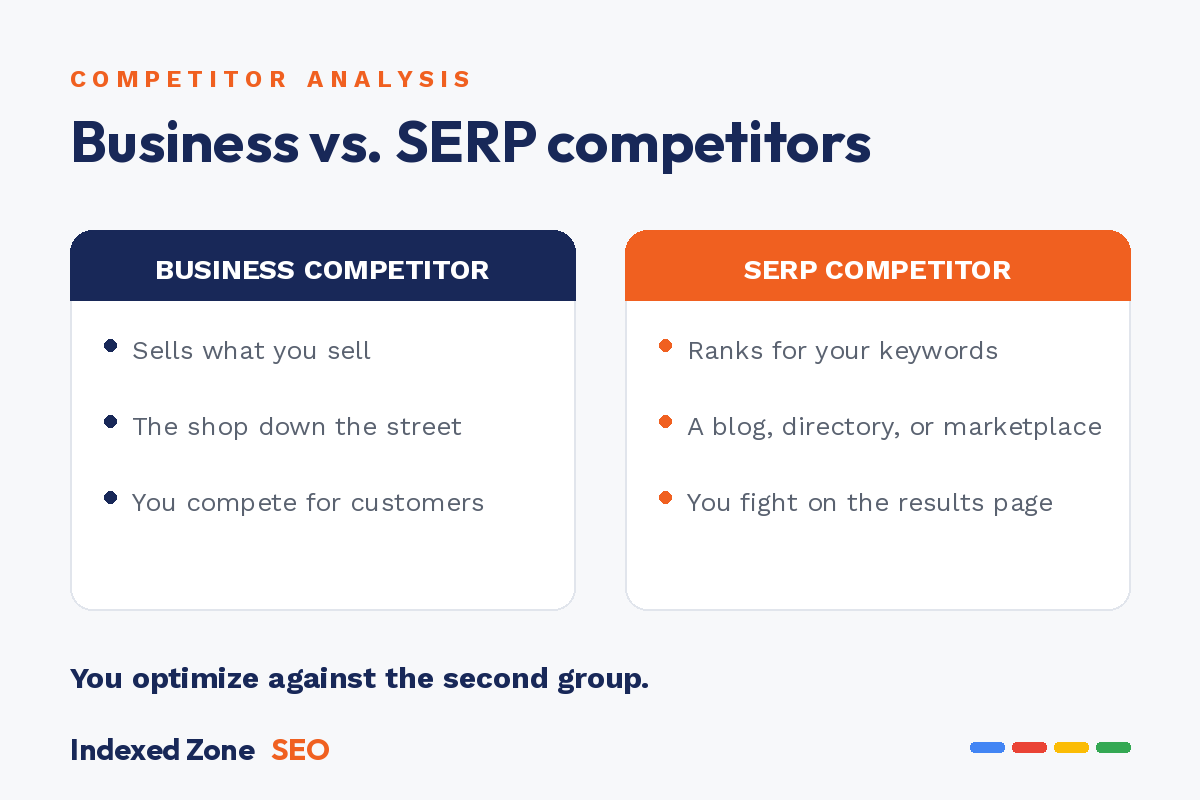
Before you can build a competitor analysis in SEO strategy, you need to know who belongs in it. Most businesses default to their obvious industry rivals, the company down the street, the brand they compete with for customers. Those matter, but they’re often not who you’re competing against on the search results page.
Your real SEO competitors are whoever ranks in the top 10 for the keywords you want to own. That list frequently includes players you’d never think to benchmark against: a niche blog that’s built years of topical authority, a marketplace site with domain-wide trust, or a national brand that happens to have a strong page targeting your exact phrase.
To build this list properly:
- Search your 10–15 most important target keywords manually and record who shows up consistently, not just once.
- Separate “business competitors” from “SERP competitors”: you’re tracking the second group for this exercise.
- Note which competitors show up across multiple keyword clusters versus just one page for one term. Repeat offenders deserve the closest attention.
In our experience, this step alone reshapes a client’s whole strategy. A local service business we’ve worked with assumed their biggest threat was a competitor across town. Their real SERP competitor turned out to be a directory site ranking for a dozen of their target terms with thinner, weaker content, which meant it was a winnable fight, not an uphill one.
How to Find Competitors’ SEO Keywords (and What to Do With Them)
Once you know who to study, the next step is figuring out what’s driving their traffic. This is where most teams start and, unfortunately, where a lot of them stop. Keyword gap analysis is useful, but only if you know what to do with the output.
Finding the keywords
A basic keyword gap analysis compares your ranking keywords against a competitor’s and surfaces the terms they rank for that you don’t. Most SEO platforms (Ahrefs, Semrush, and similar tools) have a built-in gap-analysis feature for exactly this. If you’re doing this manually or want a deeper foundation before you compare anyone, our SEO keyword research guide walks through how to build out a full keyword list from scratch, which makes the gap analysis far more useful once you have your own baseline to compare against.
Prioritizing what you find
A raw list of “keywords they rank for that you don’t” isn’t a strategy, it’s a spreadsheet. Filter it down by:
- Relevance: does this keyword actually match something you sell or offer, or is it adjacent noise?
- Intent: is the searcher ready to buy, comparing options, or just researching? Match this against where that keyword sits in your funnel.
- Difficulty versus opportunity: a term with high volume but ten entrenched competitors is a longer play than a lower-volume term where the current top results are thin or outdated.
Rank the surviving list by how quickly you could realistically produce something better than what’s currently ranking. That becomes your content roadmap, not just a keyword list sitting in a folder.
Audit Competitor Content Quality, Not Just Topics
Knowing what topics a competitor covers only gets you halfway. The more useful question is whether their content on that topic is any good, because “they have a page on this” doesn’t mean “they have a page worth beating.”
When you review a competitor’s top-ranking pages, look past the word count and check for:
- Depth of the answer: does it resolve the searcher’s question, or does it circle the topic without committing to specifics?
- Structure and scannability: clear headers, examples, and formatting that make the content usable, not just readable.
- Freshness: content that hasn’t been updated in years is often rankable-but-vulnerable, especially for anything tied to tools, pricing, or regulations that change.
- Original insight: data, examples, or a point of view you won’t find on five other pages saying the same thing.
A page that’s technically thorough but generic in every sentence is a page you can beat without writing more: you just have to write something with a real point of view. This is often where a smaller company can out-rank a much bigger one: not with more resources, but with a page that answers the question more directly than the competitor bothered to.

Analyze Competitor Backlink Profiles
Backlinks still carry real weight in how search engines assess authority, so a competitor SEO strategy that skips this step is missing a major piece of the picture. The goal isn’t to count links, it’s to understand where a competitor’s authority actually comes from.
Pull a competitor’s backlink profile in whatever SEO tool you’re using and look at:
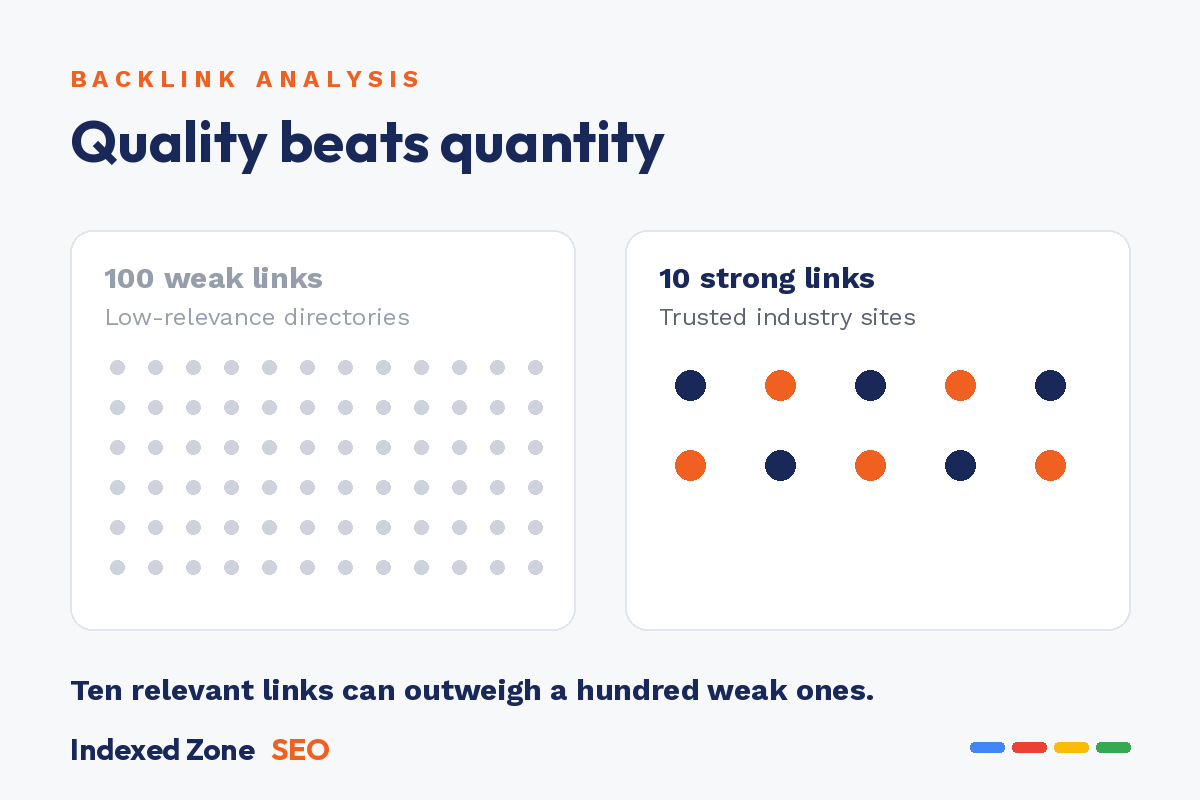
- Link quality over quantity. A hundred links from low-relevance directories carry less weight than ten from sites that are well respected in your industry.
- Link sources you could realistically earn. Industry publications, partner sites, local organizations, and resource pages are usually more attainable than links pointing to a competitor’s massive brand press coverage.
- Which specific pages attract the links, not just the domain overall. That tells you what kind of content on their site is worth emulating in your own: original research, tools, or useful guides tend to be the pages that earn links naturally.
This step is slower than keyword or content analysis, and it’s the one businesses skip most often because it doesn’t produce a quick win. But it’s also usually where the real competitive gap lives, especially in industries where several sites have comparable content quality.
Benchmark Technical SEO and Site Experience
Two pages can target the same keyword with similar content quality, and the one that loads faster and works better on mobile will often win. This is the part of an SEO competitor strategy that’s easiest to overlook because it’s invisible in the content itself.
Run a basic technical comparison between your site and your top SERP competitors:
- Core Web Vitals: page speed and load stability, particularly on mobile.
- Site structure: how many clicks from the homepage to a given page, and whether the internal linking supports that page’s importance.
- Mobile experience: layout, tap targets, and readability on a phone screen, not just a desktop preview.
- Indexation and crawl health: whether their important pages are getting properly indexed, and whether yours are too.
You don’t need a full technical audit to get value here. A spot-check across your top five competing pages against your own is usually enough to spot whether this is a real gap or a non-issue.
Study SERP Features and Search Intent Signals
The search results page itself tells you a lot about what a search engine believes searchers want for a given term, and that shapes how you should build your competing page.
Before writing or rewriting a page, check what’s actually showing up in the results for your target keyword:
- Featured snippets: if one exists, study its format (list, table, short paragraph) and structure your content to be a stronger, more precise answer to earn or reclaim it.
- People Also Ask boxes: these are a free list of related questions your content should probably answer.
- Local pack or map results: a strong signal the keyword has local intent, which changes what “winning” content looks like.
- Content format patterns: if every top result is a comparison table or a step-by-step guide, that’s the format searchers and the algorithm both expect for this query.
Matching the expected format doesn’t mean copying it. It means not fighting the intent signal the SERP is already giving you for free.

How to Beat Competitors in SEO: Turning Analysis Into Action
All of the analysis above is only useful if it changes what you do next. This is where a lot of competitor research quietly dies in a spreadsheet nobody opens again.
A workable way to prioritize action:
- Start with your biggest, most winnable gaps first: high-relevance keywords where the current top-ranking content is weak, outdated, or thin.
- Fix or create the page, using what you learned about format, depth, and structure from the SERP itself, not a generic template.
- Address the technical or backlink gaps feeding that specific page, rather than trying to fix your whole site at once.
- Re-check rankings and competitor pages on a set schedule (monthly for competitive terms, quarterly for the rest) because competitor content, backlinks, and SERP features all shift over time.
Treat this as a cycle, not a one-time project. The businesses that keep winning rankings over time are the ones who revisit this process regularly, not the ones who ran it once and moved on.
How to Separate Your SEO Strategy From the Competition
Here’s the part that’s easy to miss: if your entire strategy is “match what the top competitor is doing,” you’ll never beat them, you’ll just eventually tie them. Competitor analysis should tell you where the bar is, not become the ceiling.
The businesses that separate themselves from their competitors in SEO tend to do a few things differently:
- They answer questions competitors gloss over, using specifics (real numbers, real processes, real examples) instead of the same generic advice repeated across the SERP.
- They build content around their real, lived expertise rather than what’s easiest to write, which is a big part of how search engines and readers judge credibility.
- They treat competitor research as a starting point for a better answer, not a template to fill in with their own logo.
This is also where working with a team that does competitor analysis for a living tends to pay off, since spotting the difference between “what’s ranking” and “what’s actually winnable” takes pattern recognition built from doing it across a lot of industries. If you’d rather have that process handled for you, Indexed Zone SEO runs this kind of analysis and strategy work directly with clients.
FAQ
How often should I run a competitor SEO analysis?
For competitive, high-value keywords, check quarterly at minimum, since rankings, content, and backlink profiles shift. For lower-priority terms, twice a year is usually enough to catch meaningful changes without burning excessive time on monitoring.
What’s the difference between a business competitor and an SEO competitor?
A business competitor sells what you sell to the customers you want. An SEO competitor is whoever actually ranks for your target keywords, which is sometimes a completely different set of sites, including directories, publishers, or marketplaces you wouldn’t normally think to compete with.
Do I need expensive tools to do competitor analysis?
Not to start. Manual searches and free tools like Google Search Console can surface a lot of useful signal. Paid platforms speed up keyword gap and backlink analysis considerably, which matters more as the number of competitors and keywords you’re tracking grows.
Should I copy what my top-ranking competitor is doing?
No. Use their page as a floor, not a template. Match the format and depth the SERP is rewarding, then go further with specifics, examples, or original insight their page doesn’t have. Matching a competitor gets you close; exceeding them is what actually moves rankings.
How long does it take to see results after acting on competitor analysis?
Typically a few months for meaningful movement, depending on competition level and how much the target pages needed to change. Technical and content fixes on existing pages tend to show results faster than brand-new pages still building authority.