With the rollout of AI mode, digital marketers are faced with the challenge of adjusting their understanding of search once again. If you are still relying on keyword density, meta descriptions, and getting to position #3, you are going to get left behind. The landscape has changed. We are now in the era of Google AI mode SEO, and it is changing the way we do SEO and search.
What is Google AI Mode? Why do you need to care?
Google AI Mode is not just an algorithm change. Google AI Mode is a completely different way of thinking about how search functions. We’re talking about large language models (Gemini, specifically) merging with traditional search infrastructure to serve up conversational, dynamic answers instead of the familiar list of blue links.
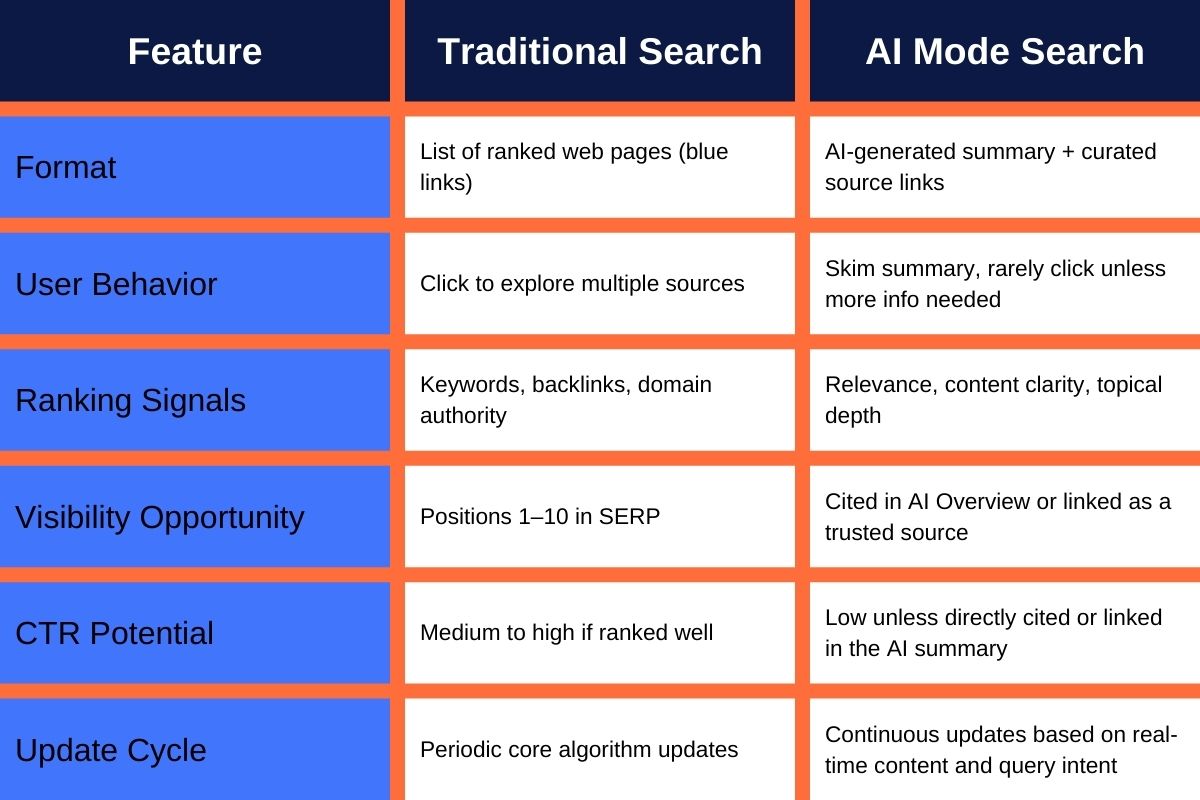
Search Engine Results Pages are no longer simple. Instead, we have AI summarizations, direct answers, and synthesized answers for our queries. In some cases, traditional results don’t even appear until after the user has scrolled down.
Let’s explore the situation step by step:
- Your site is experiencing a decrease in organic visibility. The AI Overviews push standard listings further down the page, even below the first viewport.
- Intent is beating keywords. Google is trying to figure out what you mean, not what words you used.
- Certain signals matter differently now. Engagement, topical depth, and even structured data seem to matter a lot.
- Experience-based content is winning. Content with real EEAT—such as product reviews and first-person narratives—gets rewarded.
- It’s personalization on steroids. Your past searches, the context, and even your previous questions influence what you see.
- Ads are integrated. AI summaries now include shopping results and sponsored content.
The impact of Google AI mode on SEO has been severe for some sites. They did nothing wrong, and traffic was heavy because the rules changed overnight.
AEO and GEO: The New SEO Playbook
Currently, two terms are essential: Generative Engine Optimization (GEO) and Answer Engine Optimization (AEO).
GEO focuses on how to make your content more palatable to AI systems that provide answers instead of ranking pages. Generative engines pull out snippets from different sources and compose answers. Your objective should be to create “quoteable” content that has contextual richness and a structure that is friendly for AI content extraction.
AEO aims to place your content in one of the direct answer boxes, the featured snippets, and AI summaries that preface the rest of the content. This includes writing content that is responsive to searches, utilizing FAQ and list formats, and using schema markups so Google can understand your content.
In other words, you are not trying to get top rankings anymore. You are attempting to get your content utilized by AI systems, even if you do not appear in the top 3 results.
New tools such as Profound, Athena, and Scrunch AI are emerging to help businesses monitor and enhance their presence in AI. It is emerging as a self-contained environment.
How to Optimize for Google AI Mode Today
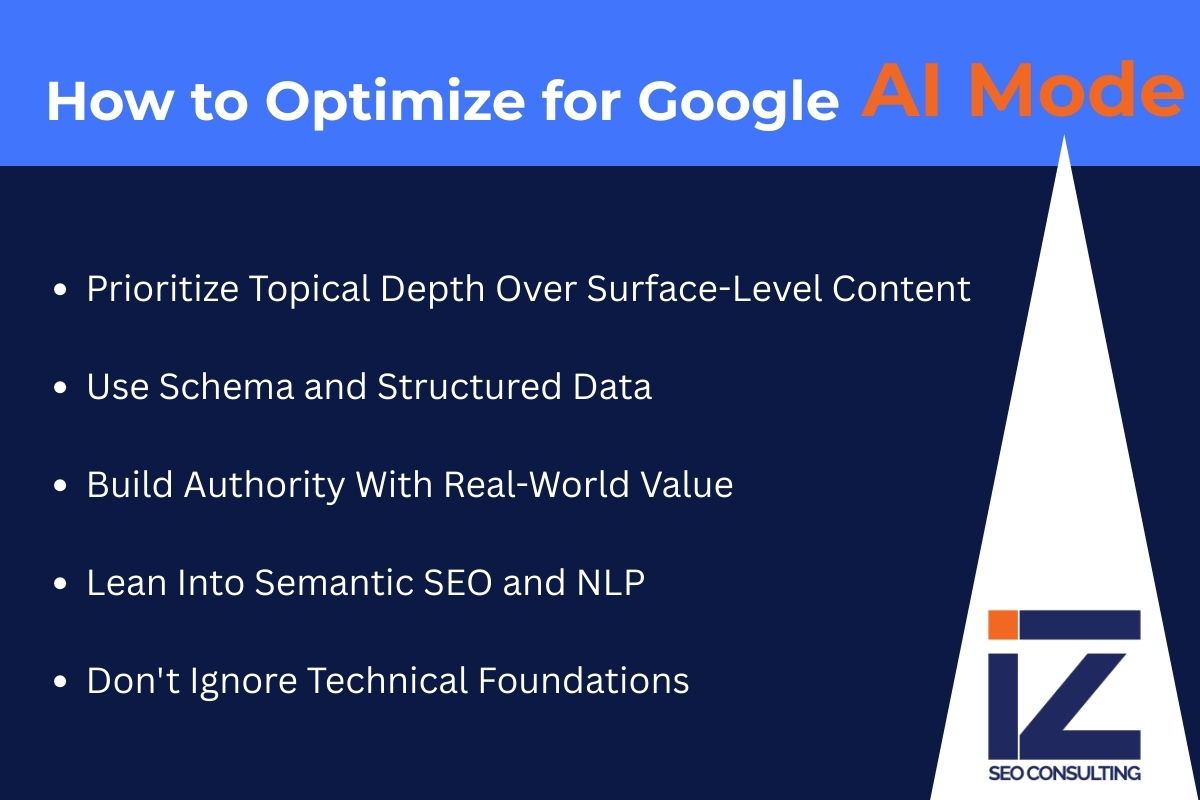
1. Prioritize Topical Depth Over Surface-Level Content
2. Use Schema and Structured Data
Google AI mode SEO relies heavily on structured data to understand and extract content effectively.
- Mark up FAQs, reviews, products, and how-tos
- Use technical SEO best practices to ensure crawlability
- Optimize for entities, not just keywords
3. Build Authority With Real-World Value
Google is doubling down on Experience and Expertise requirements.
- Highlight author bios with real credentials
- Add unique perspectives, case studies, or test results
- Encourage user interaction—comments, votes, etc.—to boost engagement signals
4. Lean Into Semantic SEO and NLP
Content creators should use semantically related phrases and structure their content like an answer, not an article. This helps align with how AI understands and ranks content.
5. Don’t Ignore Technical Foundations
Even in the AI-first world, your site’s technical health still matters. AI systems rely on a clean, accessible structure to interpret and extract information accurately. If your site is slow, poorly structured, or hard to crawl, it’s less likely to be included in AI-generated responses.
How to Get Your Content Into AI-Generated Overviews
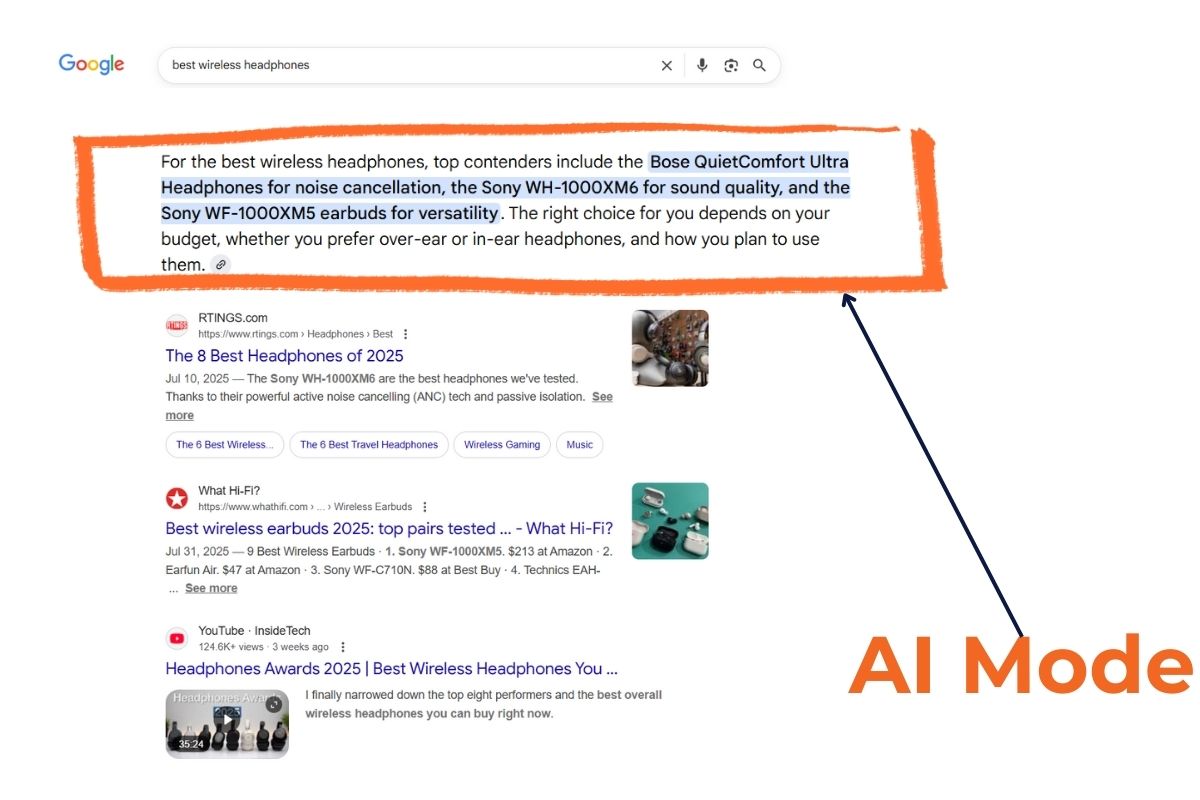
Google AI-generated summaries are a type of answer box that appears at the top of SERPs. These summaries consolidate information from several credible sources to answer a question, without requiring users to click on any of the sources.
The following factors contribute to the type of content that Google’s AI will incorporate into the summaries:
- Offers original content that is difficult to find, such as original data, personal narratives, unique statistics, primary sources, etc.
- Answers specific questions in a concise and clear manner, including the use of bullet point lists, and employing short paragraphs of 2-4 sentences
- Has appropriate structured data markup
- Provides content from domains that show a high degree of expertise, authoritativeness, and trustworthiness (EEAT) and demonstrate in-depth user engagement
- Contains well-written content that sounds credible and not artificially generated through a keyword stuffing algorithm
Additionally, it is important to note that Google AI does not use one source to answer a question. It uses information from several sources to answer the question. Even smaller or newer sites, as long as the content is clean, relevant, and useful, might get featured.
Performance of content formats:
- Guides on how to
- Sections with frequently asked questions and straightforward definitions
- Tables of comparison
- Short paragraphs that focus on a specific intent
- Pages that center around questions that are frequently asked, such as how to and what is, what is the best way, etc.
Although getting into an AI Overview might not flood your site with traffic, it establishes trust, visibility for your brand, and valuable SEO for the future, especially in an AI-focused world.
Tracking Performance in the AI Mode Era
Google’s AI mode is impacting SEO and how search is performed, making traditional rank tracking methods outdated. To keep up with the changes, Google Search Console has incorporated new features that help users monitor possibilities that are driven by AI.
You need to keep an eye on the following:
- Clicks on AI Overviews
- References in responses generated by AI
- Responses provided by AI that include the searched site
Emerging GEO tools and Wix are making features available that aid users in AI mode SEO. We are in a new age of measurement.
SEO professionals are also rethinking KPIs as a result of the changes. With fewer clicks and more direct answers, traffic alone doesn’t tell the story anymore. Focus on:
- Visibility within AI summaries
- Brand mentions
- Share of AI-generated citations
Recent Changes in the AI Mode SEO Landscape
Other Players Implementing Google AI Mode Gemini
Until Google I/O 2025, Gemini powered Google’s AI Mode integration. Gemini is a multi-modal AI, capable of analyzing and understanding (not just skimming) web pages and all the main types of media (text, images, videos) and file types (code, documents, audio).
For SEO, this understanding of web pages allows Google to analyze details and report on the intention of the users. Google is moving away from reporting based on the What, How, or Why of the entry to the system and is instead providing user-intention-based answers. Google’s AI Overview leverages multiple content types to generate AI syntheses.
Other Models
Google AI Overviews relies on Gemini, but it is not the only source. For the content creation, structure, and optimization of content, Google AI Overviews relies on Open AI Chat GPT, Anthropic Claude, and Meta’s LLaMA. These AIs generate reviews and are incorporated into most CMS plugins, e-commerce systems, etc.
Integration across AI systems means you are compelled to optimize systems in the cloud and those based on Open AI. Google’s AI systems will perform suboptimally in systems based on ChatGPT and will yield poor results in Perplexity. Universal best practices include structure, straightforwardness, and completeness.
The most significant integration of AI systems is in content creation. From WordPress content creation assistants to automated schema creators, and from AI product describers in Shopify, the composite systems are significantly modifying the scale of content creation.
The AI Search Impact on Product Reviews and Ratings 2025
The AI search impact on product reviews and ratings 2025 shows AI summaries pulling snippets from trusted sites with authentic user experiences. Generic affiliate content without substance gets buried. Reviews not grounded in firsthand use or real photos are losing visibility dramatically.
Critical statistic: Publishers and review sites have reported organic traffic drops of up to 55% since the Google AI mode update in May 2025.
AI Updates May 2025: What Changed
The AI updates in May 2025, at Google I/O 2025, marked one of the biggest SEO shifts in recent history. Nearly a year later, these changes have fundamentally reshaped the search landscape. Key changes included:
- Interaction-based ranking: Click depth, scroll behavior, and time spent now carry significantly more weight than traditional metrics.
- AI-generated summaries dominate: Organic listings continue to be pushed down as AI Overviews expand to more query types.
- Schema importance multiplied: Structured data has become essential, not optional, for AI content selection.
- Search personalization accelerated: AI builds upon previous user queries and behaviors to deliver increasingly customized results.
- Ads and shopping modules embedded: Feed optimization and campaign structure now directly impact AI Mode visibility.
These changes reflect a wider trend in how AI is changing SEO fundamentals. SEO is no longer about static rankings; it’s about becoming the preferred source that AI systems want to reference and utilize. After these updates rolled out, the industry has adapted to this new reality, though many sites are still recovering from the initial traffic impacts.
Why Multimodal Content is Important
AI mode does not purely read text. It handles content in different formats:
- Video transcripts: Transcripts help Google capture the topic for a possible AI response for YouTube videos
- Audio and podcasts: Spoken content is parsed and indexed with transcripts
- Infographics and charts: Visuals indexed with descriptive alt text and contextual information help the website’s authority
- Images: Descriptive screenshots, product photos, and instructional images add value
Layered information is preferred by AI. It is able to better recognize and utilize content when it is presented in multiple formats: explanations, text, visuals, and audio.
How Is AI Changing SEO? Real Examples
A recent case study is a great example of emerging trends:
- After launching AI mode, a niche medical blog with high-quality, thoroughly researched content and posts written by physicians experienced a 30% increase in traffic
- A listicle website with low-quality, shallow content experienced a 50% decline in visibility overnight
- Enterprise websites effectively utilizing aggregable content, content with schema markup, and a coherent topical hierarchy are thriving
What’s the pattern? The emerging SEO ranking factors are quality, structure, and context.
What SEO Ranking Factors Still Matter in AI Mode?
Some things are different. Changes in these factors are still important:
- Page speed and Core Web Vitals
- Backlink quality (contextual, relevant, not spammy)
- User engagement metrics
- Internal linking structure
- Schema usage
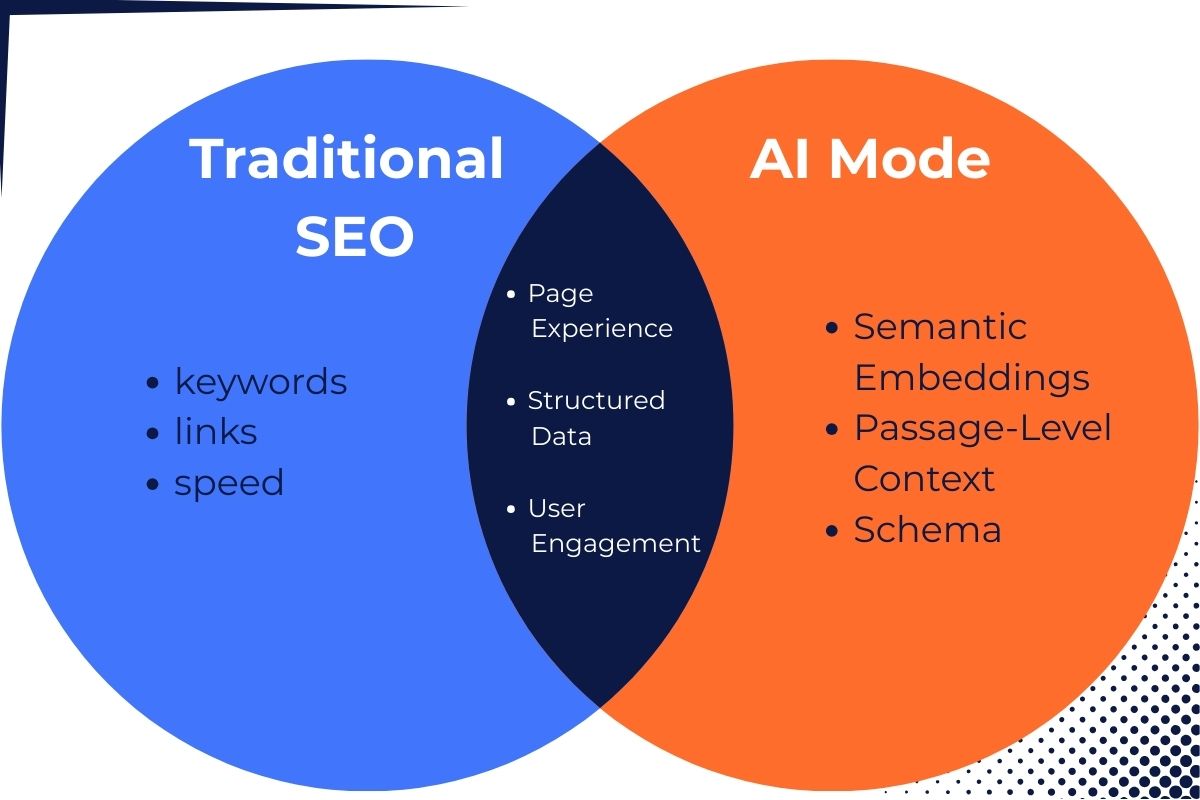
But with AI, there is an emphasis not just on page-level keyword metrics, but on passage-level relevance and semantic embeddings. Industry professionals refer to this as relevance engineering. This is optimizing content to align with AI systems’ methods of indexing, storing, and retrieving meaning, beyond linking.
Pro Tip: Optimize for Query Paths, Not Just Keywords
Content mapping to query paths is an advanced practice. These paths are the stages in the search behavior of the user. For example:
“Best laptops for video editing” → “MacBook M3 vs Dell XPS 17 for Premiere Pro” → “benchmark 2025 export time”
It is important to create content that answers every question within the journey. AI systems pull from relevance on multiple steps instead of one keyword. Understanding how to rank in AI mode requires this approach.
Common Pitfalls and Misconceptions
Many professionals incorrectly think:
- AI summaries only analyze the top 3 results, which is incorrect
- Old content is outdated and useless, but if the content has been revised with current information and structured properly
- Being brief is best, which is false unless information is presented thoroughly and in an unambiguous manner
- AI makes no mistakes, which is false. The AI mode makes improper assumptions and oversimplifies arguments, which is why well-structured, supported, and reputable information is more important than ever
Reality check: The AI mode’s effect on SEO champions truth, expertise, and usefulness. Superficial or keyword-stuffed content will be unsuccessful.
Final Take: How to Survive and Thrive in the Future of SEO With AI Search
Adapting to SEO advancements and AI integrations is not an optimization issue. The primary goal should be to adapt strategically.
Here is an outlined strategy:
- Examine content and check for depth and structural attributes, alongside experience indicators
- Apply structured data markup to content
- Incorporate new media content (videos, podcasts, infographics) to enhance breadth
- Utilize tools aware of AI Mode to analyze performance
- Apply AI-driven expectations (GEO/AEO) for sustained results
- Adapt the definition of success to encompass citations, AI summary, brand visibility, and presence share
Google AI mode optimization makes searching more efficient. The changes AI brings to SEO strategy may be viewed as impeding progress, but those most willing to adapt will win.
For companies that lack the necessary expertise to manage the changing environment, collaborating with seasoned professionals as Indexed Zone SEO, can offer the nuanced guidance to succeed in the search ecosystem shaped by Artificial Intelligence.