The most fundamental question is understanding the difference between white hat vs black hat SEO. Ignoring black vs white hat SEO is detrimental, and not understanding this will very well determine the fate of your website since these two opposing approaches are the deciding factor between sustainable growth and penalties that are detrimental to your site. This guide will cover all the major domains of black and white hat SEO, covering the techniques, penalties, and consequences of black and white hat SEO in the real world.
White Hat and Black Hat SEO: The difference
There is a difference between white hat SEO and black hat SEO, primarily in the techniques and the end goals of these two approaches. The difference primarily lies in the approach and the methodology, as white hat SEO approach is compliant with the search engine guidelines, while focusing on a positive user experience, and gaining authority with the use of legitimate long-term strategies, on the other hand, black hat SEO will manipulate and deceive the user using the search engine strategies and algorithms to gain quick and unattainable goals. Black hats will try to gain quick and unsustainable goals while ignoring the consequences of deceptive measures. White hat will gain sustainable goals while doing the same. White hat builds a house on a solid foundation, while black hat builds a house on sand and hopes the tide will not come in.

White Hat SEO: Building for the Long Term
White hat strategies will stick to the search engine guidelines and will build real value. This will come at a cost as the strategies will need to be invested a lot of time, but in the long run will be worth it.
Core White Hat Practices
- Original, authoritative content: Research-backed articles that answer user questions comprehensively, not thin pages designed solely for rankings
- Strategic keyword research: Understanding search intent and naturally incorporating terms where they serve the user
- Earned backlinks: Creating content so valuable that other sites link to it organically, or building genuine industry relationships
- Technical optimization: Fast loading speeds (under 2.5 seconds), mobile-responsive design, clean crawlable structure, and proper HTTPS implementation
- User experience signals: Low bounce rates, high engagement time, clear navigation, and accessible design
- Structured data markup: Helping search engines understand content context through proper schema implementation to build discovery and relevance for search engines
- E-E-A-T signals: Demonstrating Experience, Expertise, Authoritativeness, and Trustworthiness through author credentials, citations, and transparent information
Timeline Reality: White hat SEO typically shows measurable results in 4-6 months for lower competition keywords, 6-12 months for moderate competition, and 12-18+ months for highly competitive spaces.
Black Hat SEO And Search Engine Regulations
Google has improved its systems in the following ways:
- Machine Learning: AI systems like SpamBrain are able to pick out spam and other forms of bad practices. They use data about relationships between links and other forms of content and user interaction.
- Human Review: Google has thousands of employees as quality raters. They are responsible for flagging websites for penalties that are applied manually.
- Pattern Recognition: Google has automatic systems for flagging things like spam link building (especially in terms of anchor text) and shady referrer traffic.
- User Interaction: Google uses bounce rate to gauge the quality of content.
- Crawl Data: Google is able to check for cloaking through a number of methods. They can compare cached versions of the same page from different data centers, look at the server response, and check the content on the server.
Detection systems have improved massively in a very short amount of time.
What is The Danger of Black Hat SEO
Types of Penalties:
- Algorithm Penalties: The algorithm determines that you have violated the terms of service, and as a result, your page rank goes down. To recover from this, you have to fix the violations and then wait for the algorithm to crawl and update.
- Manual Actions: Google employees manually review your site and then apply penalties. You get a message about this in the Search Console, and then you have to fix the problem and wait for an employee to review it again.
- De-indexing: A site can get completely removed from Google’s index, which can take 6 months to a year to recover from, if at all possible.
Real World Examples
- J.C. Penney (2011): They were found using a paid links scheme, causing them to fall from the first pages of search results to the 6th and beyond for many important search terms. They needed more than a year to recover and rebuild their trust.
- Overstock.com (2011): Overstock also fell victim to link-building penalties by giving discounts to schools and universities that would provide backlinks to their site. They lost millions in revenue, and their search engine rankings fell dramatically.
- Rap Genius (2013): Provided backlinks in exchange for site exposure, a link-building scheme. They were de-indexed for a few days, and when they regained their rankings, their traffic was down 700% because they were now ranked much lower.
Financial Impact
- Opportunity cost: Competitors can progress ahead for 6 to 18 months while penalty-affected sites are forced to take their foot off the accelerator.
- Loss of organic traffic: Drops between 50 and 100% in organic traffic are common after penalties are implemented.
- Revenue decline: E-commerce penalties will typically result in a 40 to 80% decline in revenue.
- Recovery costs: A penalty can result in costs from SEO cleanup by a professional, link removals, and site content updates between $5,000 and $50,000 dollars.
Gray Hat SEO: The Questionable Middle Ground
- Aggressive guest blogging on poor-quality websites for backlinks is also dangerous
- Buying expired domains for their backlink profile and using them to redirect to your site
- Misleading clickbait titles
- Overdone schema markup that exaggerates content relevance that also gives too much information
- Automated social media without tun interaction and sm spam comments to gain followers
- Gray hat is often “black hat light”– you’re still taking chances on the future of your site, and using poorer techniques than a bunch of what black hat techniques are set out to do
Examples of Black Hat and White Hat SEO in Action
Let’s break down a few real-world comparisons:
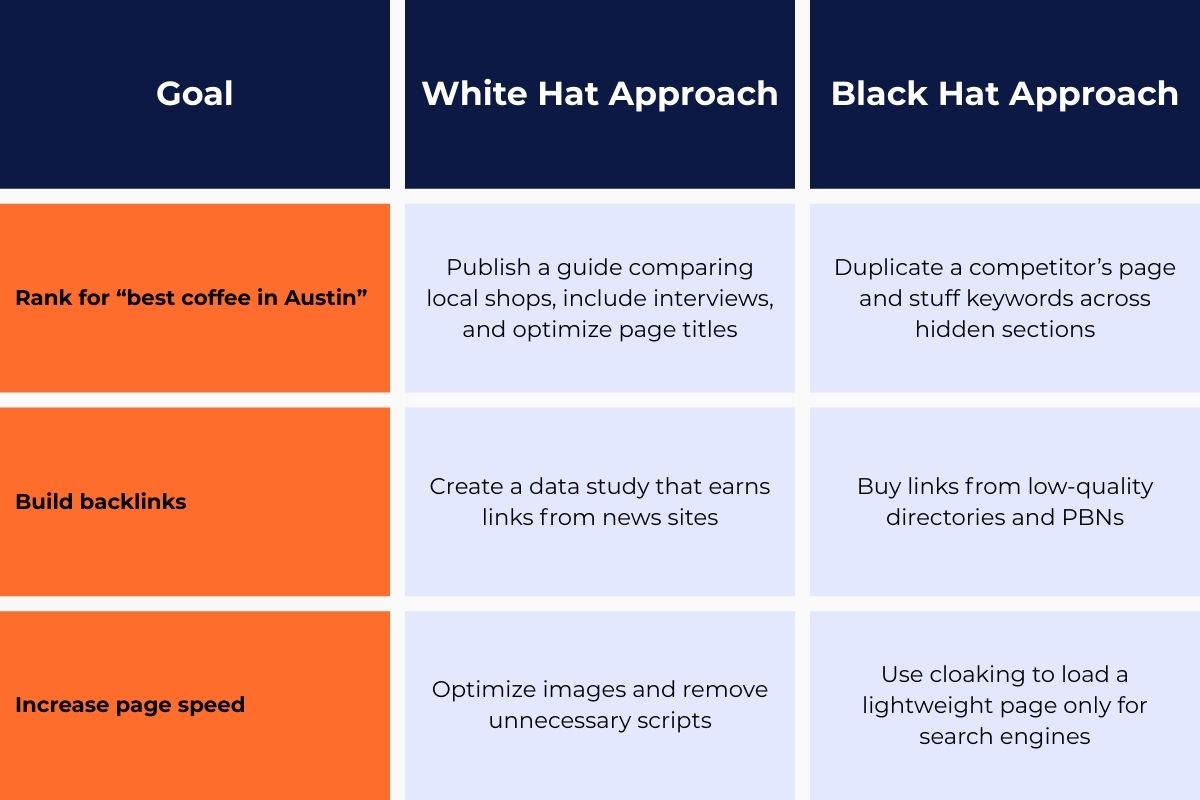
These examples of black hat and white hat SEO show just how differently the two strategies operate—and why one tends to stand the test of time.
How to Analyze Your Website for Bad SEO Practices
Even if you personally never used bad SEO practices, previous agencies you worked with, or automated tools, may have.
Step 1. Analyze Your Backlink Portfolio
- Use Google Search Console, Ahrefs, or SEMrush.
- Look for patterns, such as spikes, irrelevant, or foreign backlinks (unless you want to rank in those markets)
Just as well, sites in these markets are bad: gambling, adult, and pharmacy.
Step 2. Analyze Your On-Page Optimization
- Search for hidden text: if you select all text on a page, and there is text that is simply white on white.
- Then check for text size. It should be larger.
- Try reading the text, it should be seamless.
- Ensure there is a version of the site that the user sees that is the same as the version that Google has cached.
Step 3. Analyze Your Content
- See if the content is AI-generated with detection tools.
- Search for content duplication, both on the page and on content on other sites.
- If the content has a claim, see if there is data to support it.
Step 4. Google Search Console
- While in Google Search Console, check for the absence of manual actions in the Security & Manual Actions tab.
- Look through the coverage issues. These are often a sign of hidden content.
- Keep in mind sudden drops in visibility, and if they coincide with changes to the Google algorithm.
Step 5. Analyze Your Competition
If black hat competitors are outranking you in the short term, don’t copy. Just document what they are doing and wait for the penalties to hit.
Your competitors fall while your site improves.

Recovering from Black Hat Penalties
If your website has received a Google penalty, recovery is possible—but it requires time, accuracy, and consistency. Below is a structured process to help you regain trust and visibility.
1. Identify the Violation (1–2 Weeks)
Before taking action, you must clearly understand what caused the penalty.
- Check Google Search Console for manual action messages.
- Perform a complete site audit.
- Identify and document every instance of:
- Unnatural or toxic backlinks
- Keyword stuffing
- Cloaking or hidden text
- Duplicate, spun, or thin content
- Doorway pages or deceptive redirects
2. Remove or Disavow Harmful Links & Content (4–8 Weeks)
Once issues are identified, begin cleanup.
Link Cleanup
- Contact webmasters to request removal of harmful backlinks (expect limited responses).
- Compile remaining toxic links into a disavow file and submit it to Google.
On-Page Cleanup
- Remove or rewrite any content that violates quality guidelines.
- Delete thin pages, doorway pages, and any low-value or manipulative content.
3. Continuously Improve Content Quality
Long-term recovery depends on rebuilding trust through high-quality content.
- Replace low-quality or spun content with:
- Well-researched, original, and useful information
- Content that demonstrates real expertise
- Strengthen E-E-A-T signals (Experience, Expertise, Authoritativeness, Trustworthiness) by:
- Adding author bios and credentials
- Citing reliable sources
- Improving site transparency and usability
4. Submit a Reconsideration Request (For Manual Penalties Only)
After cleanup is complete:
- Submit a Reconsideration Request through Google Search Console.
- Clearly explain:
- What caused the penalty
- What actions you took to fix it
- Provide documentation of:
- Link removal attempts
- Disavow files
- Content improvements
- Summarize your new content and SEO strategy focused on white-hat practices.
5. Wait, Monitor, and Maintain (Minimum 3–6 Months)
Recovery takes time and consistent effort.
- Track rankings and traffic weekly.
- Continue following white-hat SEO practices only.
- Document ongoing improvements in case a follow-up request is needed.
Important Note on Recovery Timelines
A full recovery typically takes 6 to 18 months. In some cases, sites may never return to their previous rankings—especially if the violations were severe or long-standing.
Consistency, transparency, and long-term quality are the only sustainable path forward.
The Ethics and Legal Considerations
There are additional risks to black hat SEO besides the risks to your rankings.
- Brand reputation: Customers, partners, and peers in the industry will lose their trust in the brand for being manipulative to the rankings.
- Legal Risks: Some tactics (fake reviews, competitor sabotage, trademark abuse in keywords) carry legal risks.
- Industry Standards: Most professional bodies and certifications demand adherence to ethical SEO.
- Long-term Business Value: If you ever intend to sell your company, having your business be subject to penalties or employing unethical practices severely hinders valuation.
Why White Hat SEO Is the Only Sustainable Choice
- Algorithm-Proof Strategy: Google consistently rewards white hat and punishes black hat. You are building with the tide, not against it.
- Compound Returns: Quality content and earned links pay dividends in traffic and rankings for years to come. Gains from black hat tactics can disappear overnight
- Competitive Moat: Genuine authority and trust are hard to replicate quickly
- Lower Risk: No fear of waking up to zero traffic because an algorithm update flagged your tactics.
- Brand Building: White hat SEO builds your brand simultaneously with rankings.
- Better ROI Long-Term: Initial costs may be higher, but the lifetime value of the black hat boom and bust cycle is negative.
Getting Started with White Hat SEO
Month 1: Foundation
- Understand the fundamentals of White Hat SEO and the most critical terminology around it.
- Perform a technical audit and fix the most critical issues.
- Develop a user intent-based content strategy.
Months 3–6: Content and Authority
- Publish high-quality and SEO optimized content consistently (1–2 times a week minimum).
- Develop genuine relationships for backlinks and partnerships.
- Optimize existing pages for a better user experience.
Months 6–12: Scaling and Refinement
- Analyze the most successful content and topics, and double down on them.
- Broaden content clusters and internal links.
- Build relationships with industry influencers for a more natural approach to link building.
Month 12+: Competitive Advantage
- Create original data and research that others are likely to cite.
- Position yourself as a thought leader in the industry.
- Systematize your content production process.
When to Hire Professional Help
If you’re serious about SEO but in-house expertise is lacking, hiring a professional is a good idea, but be careful to choose wisely.
Black Hat Agency Warning Signs
- Guaranteed rankings in a few weeks.
- Unwilling to explain their specific tactics.
- Unusually low prices compared to the market.
- No references or case studies from reputable brands.
Questions Every Business Owner Should Ask
Before hiring, review this guide on what to ask SEO consultant candidates to ensure they stick to white hat methods.
Some key indicators about an SEO provider encompass the way they do link building, the way they do content creation, and the way they stay current with algorithm shifts.
Common Mistakes Other Sites Make
Over Optimization
While using white hat tactics, they still can become an issue if they are done excessively. Using the same type of anchor text for every internal link, stuffing the same keyword in the meta descriptions, or just using keywords in a way that makes no sense are all indicators of manipulation.
Ignoring Algorithm Updates
Since every year Google puts out 500–600 updates, a lot of the time, the updates can cause drastic changes in positioning if you do not change your strategy in alignment with the updates. These include the Helpful Content Update and Core Updates.
Blind Outsourcing
The cheapest labor on Fiverr ends up using black hat techniques that you are not aware of until you receive the penalty. Make sure you research every collaboration partner.
Competitor Copying
Just because one of your competitors ranks highest for a keyword does not automatically mean they have used solid techniques that are not a risk. They could have gone black hat and are currently sitting stable, but will not be for long.
Short-Term Thinking
SEO is a long-term practice. You can’t force an agency to be compliant with standards, especially with rules and practices that are designed to push tactics that are reckless. If you want results in 30 days of a campaign with an agency, you are doing more harm than good.
Conclusion
When black hat SEO is being used, businesses are taking a gamble that they will see an increased success rate. The problem is, they are using black hat techniques on a company’s digital presence, and that is an increasing amount of risk that is unlikely to be returned with success, if the company is in that space long-term.
Search engines strive to assist users. Any strategy that doesn’t focus on user intent will be obsolete given the billions of dollars currently being spent on AI.
You need to focus on good long-term ethical strategies. Invest in content that serves user intent. Build relationships that lead to real organic backlinks. If you want to focus on long-term growth, white hat is not just the right approach; it’s the only approach.
Want to build an effective SEO strategy that you can be proud of?
Indexed Zone SEO combines long-lasting transparency with effective results. Without shortcuts, gambling with your rankings, or trying to be clever. Just growth.