Search is changing faster than most marketing playbooks can keep up with. While traditional search engines are still relevant, more users are now asking AI tools for direct answers instead of clicking through pages of results. For marketers, this shift raises an uncomfortable question: if AI gives the answer directly, where does that leave your brand? This is where LLMO enters the conversation and why understanding it early can make a real competitive difference.
The Rise of AI Answers and What It Means for Marketing
AI-powered tools like ChatGPT, Gemini, and Copilot are changing how people discover information. Instead of typing fragmented queries and scanning multiple links, users increasingly expect a single, well-structured answer. In many cases, that answer is generated without showing obvious sources or driving immediate clicks.
This shift doesn’t mean search is disappearing. It means visibility is being redefined. Marketers now need to think beyond rankings and clicks and focus on whether their brand is recognized, referenced, or summarized by AI systems. That challenge has given rise to a new discipline closely tied to search and content strategy.
LLMO Meaning, Definition, and Core Idea
Before going deeper, it helps to clarify the basics. The LLMO meaning refers to optimizing brand content and presence so that large language models can understand, trust, and reference it when generating answers.
A practical LLMO definition would be: the process of making your brand, content, and expertise more visible and usable for AI systems that generate natural language responses. In full, LLMO large language model optimisation focuses on how AI models interpret authority, relevance, and context—not just keywords and backlinks.
In simpler terms, LLMO asks a new question: if someone asks an AI about your industry, will your brand be part of the answer or completely invisible?
LLMO vs Traditional SEO: What’s Actually Different?
At first glance, LLMO might look like a rebrand of SEO. The reality is more nuanced. Traditional SEO relies on well-known ranking factors like keywords, backlinks, and page performance, while LLMO focuses on whether a brand is recognized as a credible source when AI systems generate answers.
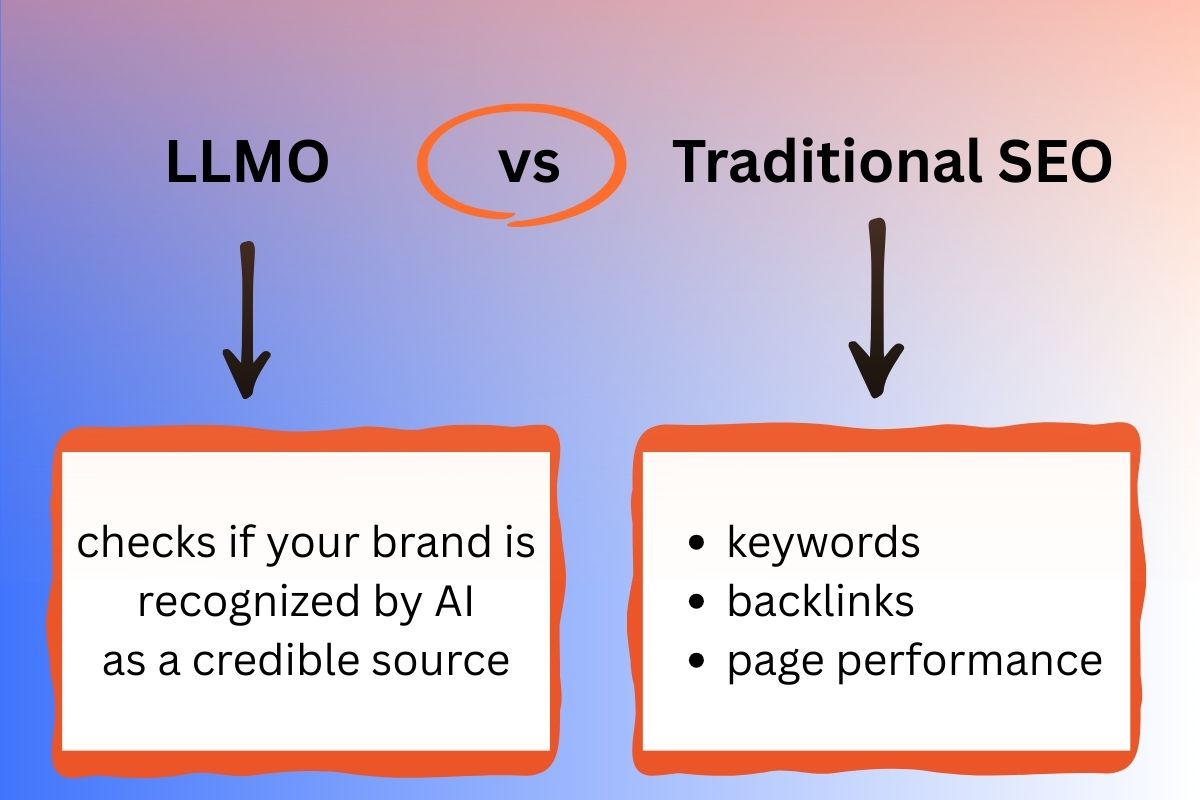
SEO rewards pages that match keywords, satisfy user intent, and earn links. LLMO, on the other hand, rewards brands that are consistently associated with clear topics, expertise, and credibility. AI models don’t just retrieve pages; they synthesize information. That means being “good enough” to rank isn’t always enough to be mentioned.
This is why conversations about LLMO often overlap with concepts like AEO (Answer Engine Optimization). Both focus on helping brands show up in direct answers, but LLMO takes a broader view by looking at how language models learn and generalize information across many sources.
Why LLMO Marketing Matters Right Now
For marketers, the biggest risk isn’t losing rankings, it’s losing relevance. If AI tools become the first stop for research, recommendations, and comparisons, brands that don’t appear in those answers may never enter the consideration set.
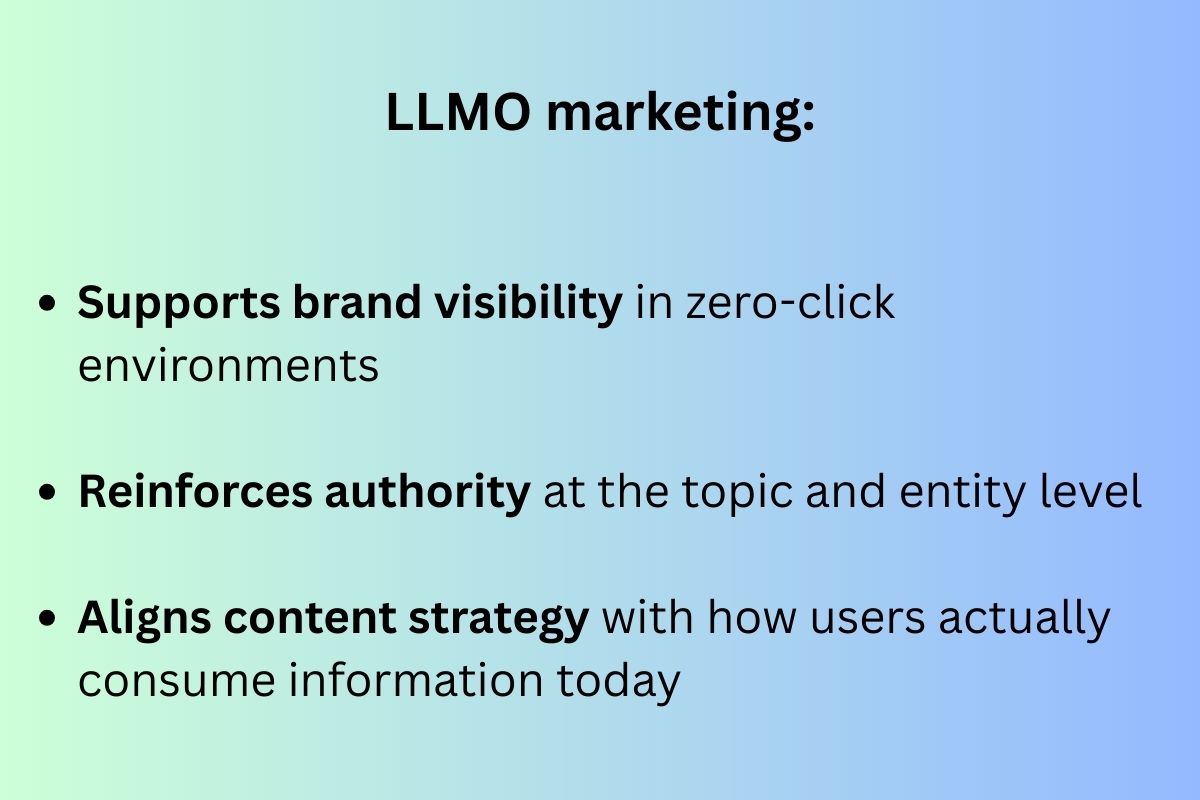
LLMO marketing matters because it:
- Supports brand visibility in zero-click environments
- Reinforces authority at the topic and entity level
- Aligns content strategy with how users actually consume information today
Early adopters are already experimenting with how your brand can show up more in Chat GPT answers, not by gaming prompts, but by building strong, consistent signals across their digital presence.
How Large Language Models Decide What to Mention
Large language models don’t “search” the web in real time, the way search engines do. They rely on patterns learned from massive datasets, reinforced by signals of authority, clarity, and consistency.
Brands are more likely to appear in AI-generated answers when they:
- Are clearly defined entities (with consistent naming and positioning)
- Publish original, expert-driven content
- Are referenced by other authoritative sources
- Demonstrate topical depth rather than surface-level coverage
This is why experts like Indexed Zone SEO emphasize alignment between technical SEO, content quality, and brand authority. LLMO doesn’t ignore SEO—it builds on its strongest foundations.
Practical LLMO Strategies Marketers Can Use Today
You don’t need to abandon your current strategy to start with LLMO. In fact, many of the most effective actions overlap with foundational elements for SEO with AI.
Start by focusing on:
- Clear, structured content that directly answers real questions
- Strong internal linking and consistent terminology
- Author bylines, expertise signals, and original insights
- Brand mentions across trusted platforms and publications
Avoid chasing trends like “AI mode” hacks or prompt stuffing. LLMO rewards clarity and credibility far more than clever tricks. Many SEO proven strategies, such as topic clustering and authority building, are still highly relevant, just applied with a wider lens.
Measuring Success Without Rankings
One of the hardest parts of LLMO is measurement. There’s no universal “LLMO score,” and no standard dashboard showing AI mentions. Instead, marketers need to combine qualitative and indirect signals.
Useful indicators include:
- Brand mentions in AI tools during manual testing
- Growth in branded search and direct traffic
- Improved performance on informational queries
- Stronger recognition within your niche
Understanding SEO terminology still matters here, but success is less about positions and more about presence. The goal is influence, not just clicks.
Common Mistakes to Avoid
As with any emerging discipline, misconceptions spread fast. A common mistake is treating LLMO as a shortcut or a replacement for SEO. Another is over-optimizing content for AI at the expense of human readers.
LLMO works best when it:
- Supports long-term brand authority
- Integrates with existing SEO and content efforts
- Focuses on real expertise, not artificial signals
When done right, it becomes another way to grow your brand with SEO, not compete with it.
The Future: SEO and LLMO Working Together
Looking ahead, the most resilient marketing strategies won’t choose between SEO and LLMO. They’ll combine both.
As search engines increasingly experiment with AI mode, users are being guided toward summarized answers rather than traditional lists of blue links – reshaping how visibility is earned. Search engines are adopting AI features, and AI tools still rely on the open web for grounding and credibility.
That means marketers who invest now in strong content, clear brand positioning, and technical best practices will be better prepared – regardless of how interfaces change. LLMO isn’t a trend to chase; it’s a shift in how visibility works.
Final Thoughts
LLMO is still evolving, but its direction is clear. As AI-generated answers become a primary discovery channel, marketers need to think beyond rankings and ask a deeper question: Does the internet understand who we are and what we’re good at? Brands that answer that question convincingly will stay visible no matter how search continues to change.